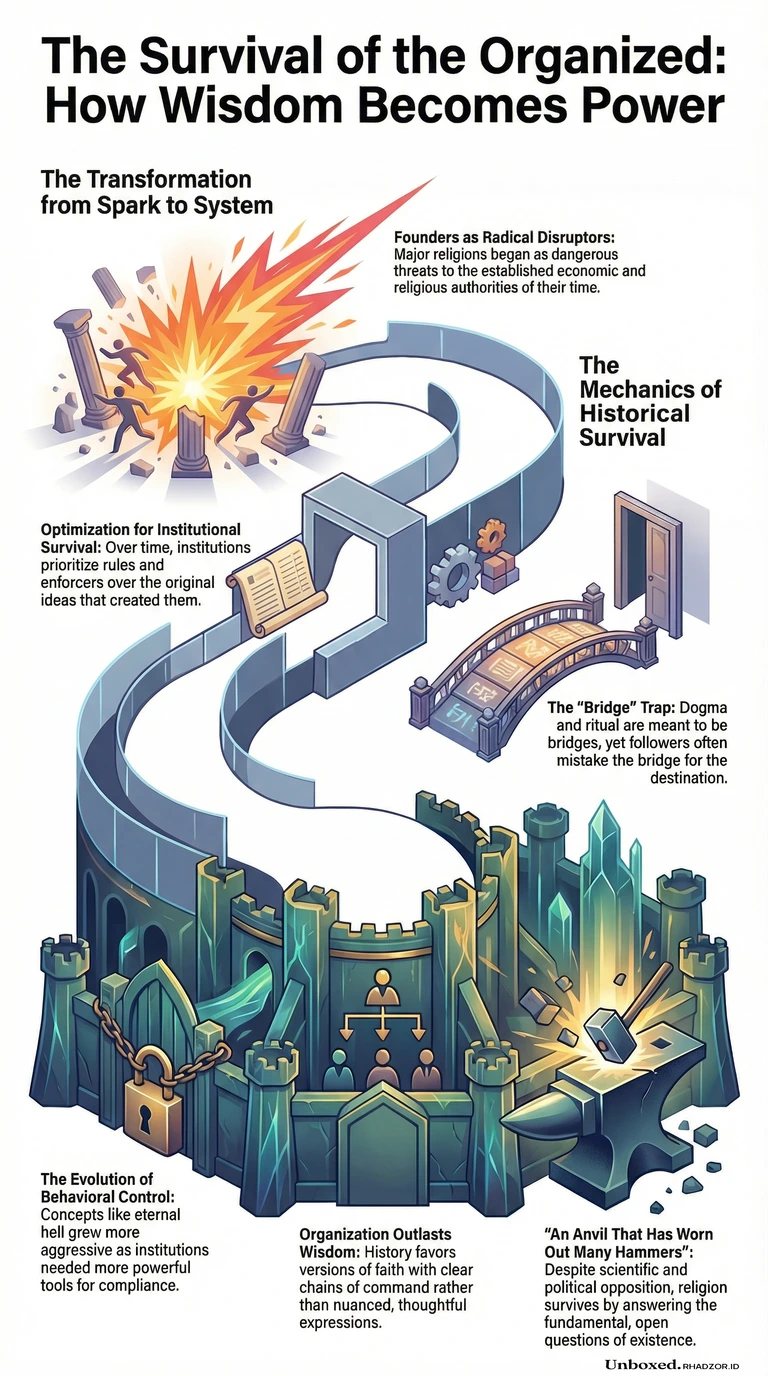
Here's something that bothered me long after I closed this book: the version of religion that survives history is almost never the most thoughtful one. It's the most organized. Holloway doesn't make a big dramatic point of this — he just traces the pattern, century by century, and lets you sit with the discomfort yourself.

So let's start at the beginning.

Every major religion you can name started as a threat to someone. Jesus wasn't building a church — he was agitating in Roman-occupied Judea, saying things that made the established religious authorities nervous enough to want him dead. Muhammad wasn't founding an empire — he was disrupting the economic machinery of Mecca, which ran on idol worship and the pilgrim trade it generated. The Buddha was a prince who walked away from everything his society had planned for him and spent years under a tree thinking about suffering.

All three were, by the standards of their time, dangerous.

And then their followers built institutions.

---

This is where the pattern gets both fascinating and depressing. Institutions form. Institutions attract power. Power needs rules. Rules need enforcers. And somewhere in that process — gradually, almost invisibly — the teaching that was meant to liberate people becomes another system for managing them.

There's no single villain in this story. No moment where someone consciously decided to corrupt the whole thing. It's more like a law of social physics: institutions optimize for their own survival over the original idea that created them. Religion isn't unique here — corporations do it, political parties do it, NGOs with the best intentions do it. The difference is that religion frames the stakes as eternal. Which makes everything considerably more intense, and considerably harder to criticize from the inside.

---

Holloway offers a simple analogy that I keep returning to. Scripture, dogma, ritual — these are bridges. Symbols pointing toward something larger than themselves. The problem is that humans have a strange tendency to fall in love with the bridge and forget where it was supposed to lead.

You don't have to look far to see this in action. Open any religious argument online — any platform, any tradition — and you'll find people hurling verses at each other, questioning each other's legitimacy, each convinced they're defending something sacred, while behaving in ways that have nothing to do with anything sacred. The bridge is on fire. Nobody's crossing anywhere.

That's idolatry in its actual sense. Not statues. Mistaking the map for the territory.

---

Then there's hell — which, it turns out, wasn't always there.

Ancient Jews had _Sheol_: a dim, quiet underworld. No fire, no screaming, no eternal torment. The vivid, terrifying version we inherited developed gradually, over centuries, and its evolution tracks with uncomfortable precision alongside institutional religion's need to maintain behavioral compliance.

Pause on that for a moment.

I'm not making a claim about whether hell exists. I'm noting that the _concept_ grew — and it grew most aggressively precisely when religious institutions needed a more powerful tool to keep people in line. Maybe coincidence. But it's the kind of coincidence that deserves more than a shrug.

---

Holloway ends with a line that feels more true the longer you think about it: _"Religion is an anvil that has worn out many hammers."_

The Enlightenment swung hard. Scientific rationalism took its shot. Soviet atheism came at it with the full weight of a state apparatus and decades of effort. None of them finished the job. Religion is still here — still organizing billions of lives, still answering questions that neuroscience and cosmology haven't quite managed to close.

Because the questions that gave birth to religion — _where did we come from, where do we go, why does any of this exist_ — those remain genuinely open. And as long as they stay open, religion isn't going anywhere.

The interesting question was never whether religion survives. It's which version of it does.

And history, as Holloway quietly makes clear, has a pattern here that should make anyone uncomfortable — believer or not. The version that wins is rarely the wisest. It's the one with the best organizational structure, the clearest chain of command, and the most effective way of making dissent feel dangerous.

Which means the most thoughtful, most nuanced, most intellectually honest expressions of any tradition are almost always the ones history leaves behind.

That's not an argument against religion. It's just an uncomfortable fact about power.

And power, as it turns out, doesn't really care what it's wearing.

---

_Unboxed | Book: A Little History of Religion — Richard Holloway_