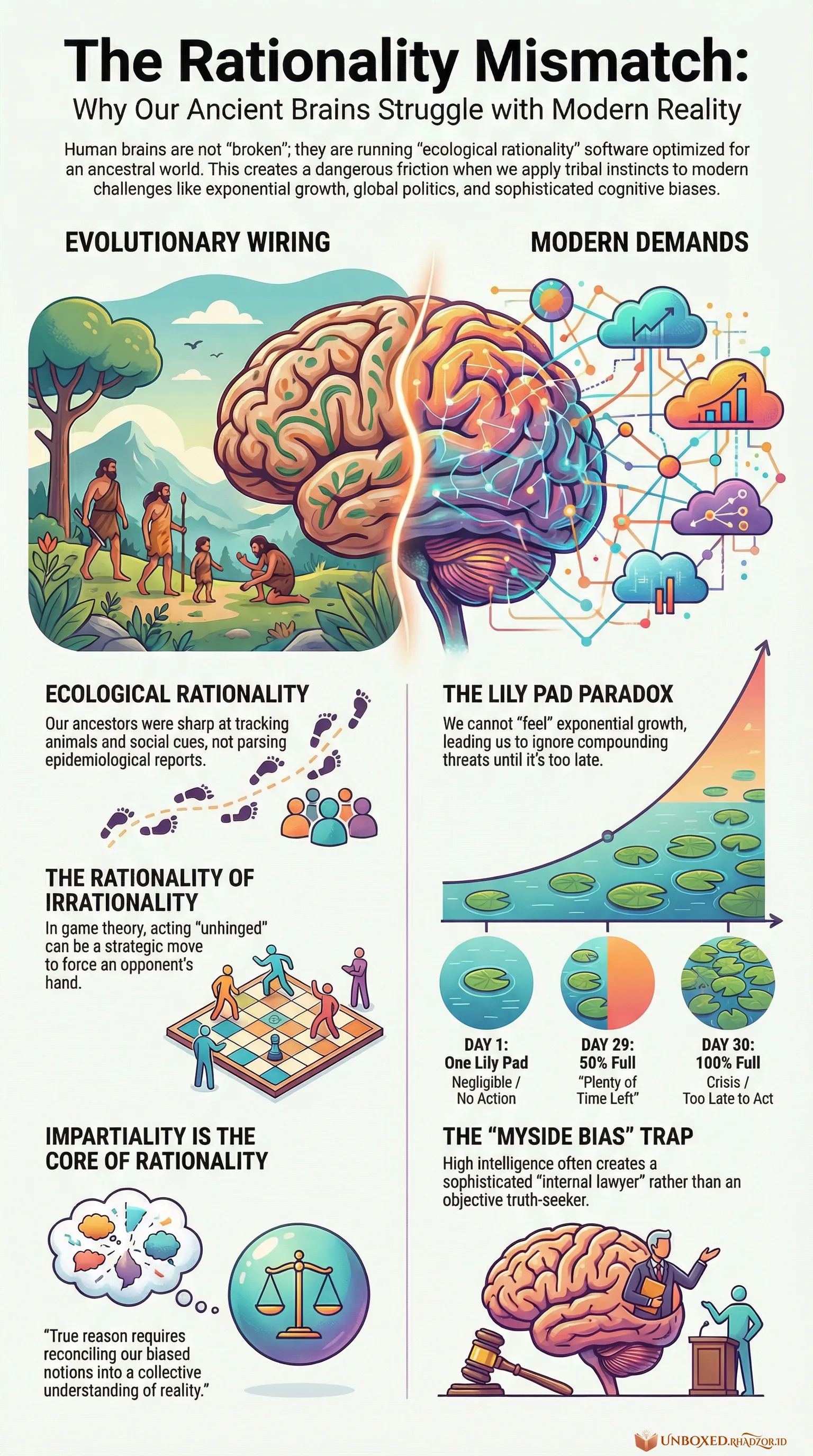
Here's the thing about conspiracy theories: they're not a symptom of stupidity. They're a symptom of a brain doing exactly what it was built to do — find patterns, protect the tribe, fill in gaps with the most emotionally coherent story available. The problem isn't the hardware. It's that the hardware was optimized for a world that no longer exists.

Pinker calls this *ecological rationality*. Our ancestors were not dumb. They were extraordinarily sharp — at reading weather, tracking animals, navigating social hierarchies, sensing when someone in the group was lying. That intelligence was precise, field-tested, and real. But ask that same brain to evaluate conditional probabilities, or parse a 47-page epidemiological report, or resist a perfectly engineered outrage feed — and it starts to short-circuit. Not because it's broken. Because it was never designed for this.

---

The thing that unsettled me most in this book wasn't about fake news or anti-vaxxers. It was a pond.

Imagine one lily pad on day one. Every day, the number doubles. On day 29, the pond is half full. When is it completely full?

Most people say somewhere around day 58. The answer is day 30.

We cannot feel exponential growth. We can *know* it — intellectually, mathematically — and still fail to act on it. This isn't an education gap. It's a cognitive architecture problem. The epidemiologists understood the curve in early 2020. The struggle was convincing decision-makers whose brains, despite their credentials, were still wired for linear thinking. Credit card debt compounds the same way. So does climate change. So did COVID. We see the numbers, nod, and then go back to operating on instinct — because instinct is faster, and the future always feels abstract until it isn't.

---

But here's the paradox I couldn't shake.

Game theory, Pinker explains, occasionally reveals that **irrationality is the most rational move**. In a game of chicken — two cars driving toward each other, first to swerve loses — the winning strategy isn't careful calculation. It's locking your steering wheel and throwing away the key. You win by making it *impossible* to be rational.

Thomas Schelling called this the rationality of irrationality. Nixon used it in Vietnam. Dictators use it. Negotiators use it. The person who convincingly loses their temper in a negotiation often walks away with more than the person who stays composed and reasonable.

Now think about the world leader you find most erratic. The foreign policy that seems unhinged. Ask yourself honestly: are they irrational — or are they playing a game whose rules you haven't fully mapped?

*Sit with that for a moment.*

---

There's another thing Pinker surfaces that I found quietly devastating: smart people are not more immune to bias. They're often *worse*.

He calls it *myside bias* — and it doesn't care about your IQ. If anything, higher intelligence just means a more sophisticated internal lawyer, one who can construct better arguments for whatever you already believe. The goal isn't truth. The goal is *winning the case*.

This reframes a lot of frustrating conversations. The problem isn't that people are uninformed. The problem is that informed, intelligent people are often working very hard — just in entirely the wrong direction.

---

Pinker quotes something that keeps coming back to me:

> *"Impartiality is the core of rationality: a reconciliation of our biased and incomplete notions into an understanding of reality that transcends any one of us."*

That's not a cold, robotic definition of objectivity. That's something almost humble — an admission that none of us sees the full picture, and that rationality is the collective project of patching each other's blind spots.

The catch, of course, is that this requires actually wanting to do that. And in an era where algorithms are very good at building warm, comfortable echo chambers, wanting to patch your blind spots is a choice you have to make against the grain. Every single day.

---

This book doesn't end with a clean answer. I don't think that's an oversight.

What Pinker is arguing — beneath all the logic and probability theory — is something almost counterintuitive: that moral progress, the abolition of slavery, the expansion of rights, the gradual reduction of violence, didn't happen because humans got kinder by nature. It happened because people applied rational arguments to expose the internal contradictions of cruelty. Reason, used persistently enough, has a direction.

But we're also, still, the species that needs reminding that the rooster doesn't cause the sunrise.

Both things are true at once. And maybe that's the most honest place to leave it — not resolved, just held.