I've been in enough conversations where someone drops the phrase "the science is settled" to know that it's usually the moment actual thinking stops.

David Deutsch — quantum physicist, relentless explainer — would probably find that phrase somewhere between lazy and dangerous. Not because he doubts science. But because the entire argument of *The Beginning of Infinity* rests on one uncomfortable premise: **knowledge is never settled**. It's guessed at, criticized, occasionally survived — and even then, held loosely.

This isn't contrarianism. It's the opposite of it. Deutsch isn't saying truth doesn't exist. He's saying we've fundamentally misunderstood how we get there.

---

The common assumption — one most of us absorbed without noticing — is that knowledge accumulates through observation. We watch enough sunrises, we conclude the sun rises. We gather enough data points, the pattern emerges. Simple. Tidy. Wrong, apparently.

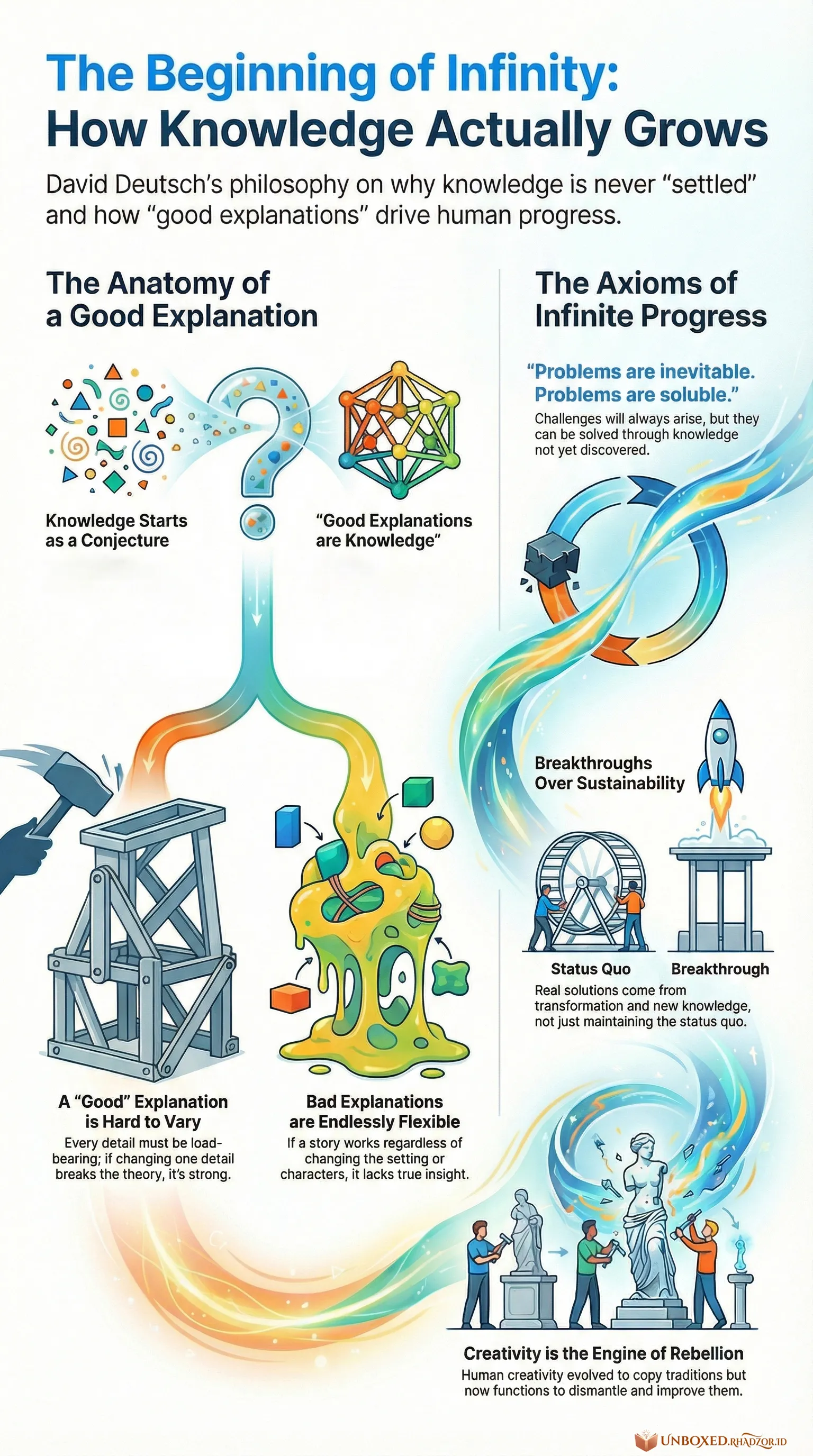
Deutsch's argument is that data never speaks for itself. Observation without a prior guess about what you're looking for is just noise. Every explanation starts as an act of imagination — a conjecture — and earns its place only by surviving criticism, not by being derived from experience.

Think about it like this: two people look at the same crime scene. One sees evidence of a burglary. The other sees a staged scene. Same data. Different prior theories about what they're looking at. The data didn't tell them anything. Their frameworks did.

Which means the real question — for science, for policy, for most things we argue about on the internet — is not *do you have data?* It's *how hard is your explanation to break?*

---

That's where Deutsch's idea of a **good explanation** becomes quietly devastating.

A good explanation, he argues, is one that's *hard to vary*. Every detail is load-bearing. Change one thing and the whole structure collapses — because it was built to explain something specific, not to sound plausible.

A bad explanation is endlessly flexible. "The earthquake happened because the spirits were angry." Swap *spirits* for *ancestors*, swap *angry* for *restless* — the story still runs. Nothing breaks because nothing was holding weight to begin with.

Now apply that filter to the narratives you consumed this week. Political, economic, cultural. How many of them could survive a character swap? A geography swap? If the same story works with different villains, different decades, different countries — it's not an explanation. It's a template dressed up as insight.

---

The paradox I keep returning to is about creativity itself.

Deutsch makes the case that human creativity — our ability to imagine things that don't yet exist — originally evolved for the exact opposite purpose: to *copy*. In static ancient societies, survival depended on replicating tradition with zero deviation. Creativity was the engine of conformity. The better you were at imagining the ancestor's way of doing things, the better you reproduced it faithfully.

And then, without anyone planning it, without any evolutionary memo going out — that same mechanism started generating rebellion, art, science, heresy.

The tool built to preserve the status quo became the thing that dismantled it.

I find this either deeply hopeful or slightly terrifying, depending on the day. Maybe that's the point.

---

There's one argument in the book where I had to sit with my discomfort for a while before I could think clearly about it.

Deutsch is skeptical of *sustainability* as a guiding value — not because he's indifferent to environmental collapse, but because he sees the sustainability narrative as structurally conservative: it asks us to freeze the present, protect current systems, and treat our existing knowledge as roughly sufficient. The goal becomes maintenance, not transformation.

His alternative isn't recklessness. It's the belief that the only real solution to resource constraints is better knowledge — not rationing, but breakthrough. Not less, but *different*.

I don't fully buy it as a complete framework. But I can't easily dismiss the shape of the argument either, which is itself a little annoying.

---

What stayed with me most isn't a concept. It's two sentences that Deutsch treats almost like axioms:

*"Problems are inevitable. Problems are soluble."*

Read fast, it sounds like a motivational poster. Read slowly, it's something stranger — two facts that coexist without canceling each other out. The problems don't stop coming. And they can, in principle, be solved. Not all of them, not now, not by us — but by someone, at some point, with knowledge that doesn't exist yet.

That's not a promise. It's closer to a track record.

---

The universe, as far as anyone can tell, is not designed for human comfort. It doesn't trend toward justice or meaning or resolution. Most of it is vacuum and radiation and indifference.

And yet here we are — the only known things in it that make explanations. That notice patterns and then argue about whether the patterns are real. That build tools to test our own guesses about reality.

Deutsch calls this cosmically significant. I'd settle for calling it *strange and worth continuing*.

Even if we're probably wrong about half of it.

---

*Especially then, actually.*