Here's the thing about reading a book written in 1997 that predicted most of what's happening now: it doesn't feel triumphant. It feels unsettling in a way that's hard to shake.

*The Sovereign Individual* opens with a simple, almost brutal premise — the nation-state, as we know it, is going the way of the feudal lord. Not because of war or revolution, but because of something far more mundane: technology quietly making the old power structure irrelevant.

Davidson and Rees-Mogg reach back to two historical collapses to make their case. The fall of Rome. The unraveling of medieval feudalism. Neither happened because someone conquered the system — they happened because a new logic emerged that made the old infrastructure unnecessary. The printing press didn't kill the Church's authority with a sword. It just made the monopoly on information untenable, and the rest followed. Their argument is that cryptography and digital assets are doing the same thing to the modern state — not attacking it, just quietly making it optional for those with the means to opt out.

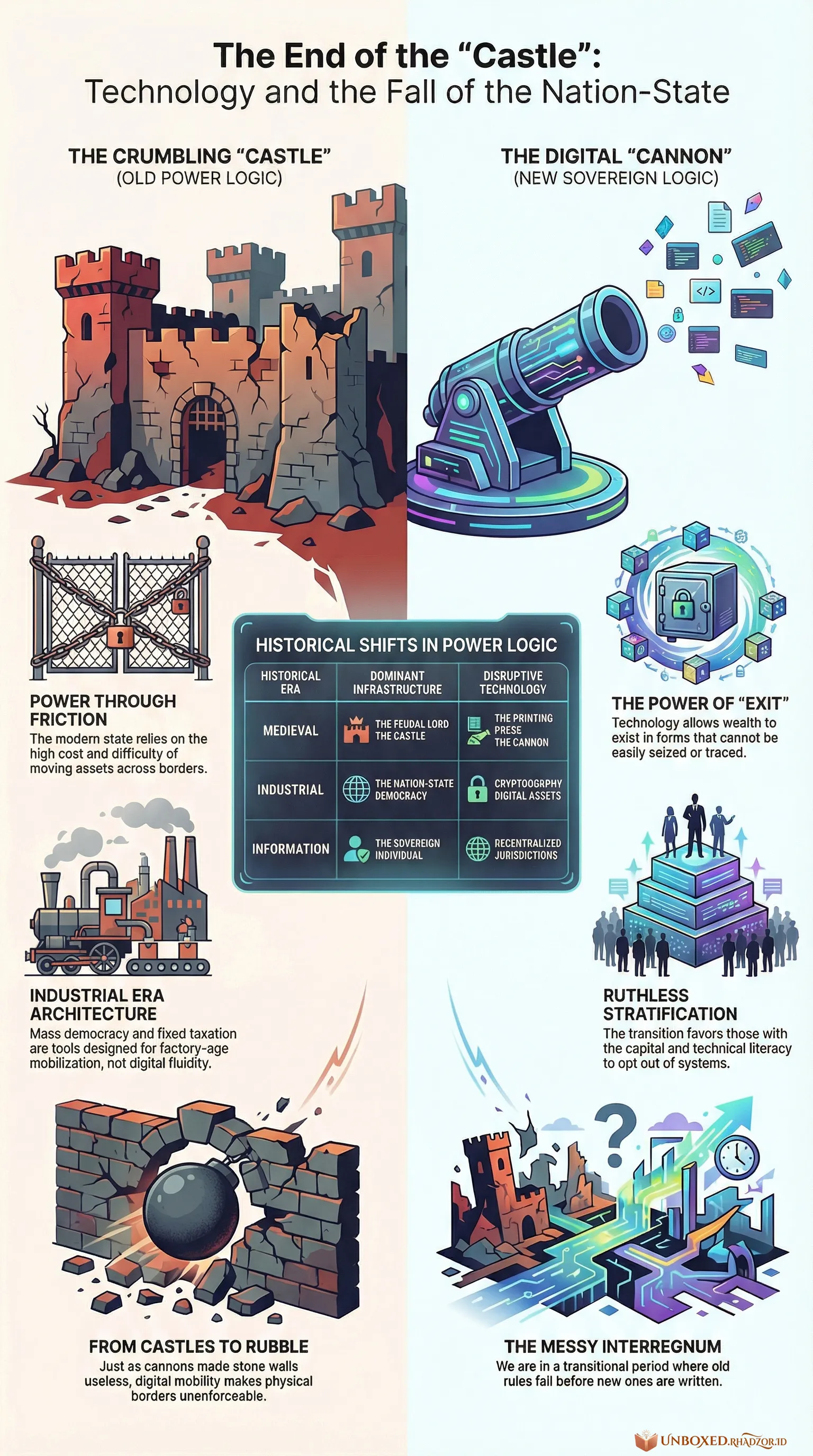
The analogy that stuck with me: for centuries, the castle was the most efficient defense technology available. Whoever built the tallest walls held the power. Then came the cannon. Within a generation, castles became either rubble or tourism. The authors argue that the nation-state is the castle of the information age. The cannon has already been fired. Most of us just haven't looked up yet.

---

What makes this harder to dismiss isn't that it sounds visionary. It's that the underlying logic is almost boring in its clarity.

The modern state, in their framing, is fundamentally a protection racket with a monopoly on violence. It taxes because exit is expensive. Moving your assets, changing your jurisdiction, restructuring your life across borders — all of it carries enormous friction. That friction is what governments depend on. But once technology allows wealth to exist in forms that can't be seized, can't be easily traced, aren't tied to geography — the entire calculation shifts.

We've already seen the early drafts of this. Tech companies routing profits through jurisdictions chosen for their tax structures. Crypto holders whose wealth exists nowhere and everywhere simultaneously. Digital nomads who live between countries without fully belonging to any of them. These aren't anomalies. They're previews.

---

But this is where the book's most uncomfortable paradox lives, and it's worth sitting with for a moment.

The "sovereign individual" the authors celebrate is someone mobile enough, educated enough, digitally wealthy enough to exit systems that no longer serve them. That sounds like freedom. And it is — for a specific subset of people. The question the book never really answers is: *sovereign for whom?*

If the only people who can opt out are those who already have access to capital, global networks, and technical literacy — then what's being described isn't liberation. It's a more ruthless stratification, one that at least has the honesty to drop the pretense of equality. The old system had narratives about fairness, even when it failed to deliver them. The new one doesn't bother.

The authors write that the transition will be "brutal for those who are not prepared." The phrasing is almost clinical. There's no grief in it. This isn't a book about solidarity — it's a book about positioning. And strangely, that makes it more honest than most books about the future.

---

The part that genuinely stopped me wasn't about technology at all.

It was the argument that mass democracy is itself a product of the industrial era — designed specifically to mobilize large populations for war and factory production. That it's not some eternal political achievement but a historically specific tool, built for a world that's now dissolving.

If that's even partially right, then most of our political arguments — who wins elections, which party holds power, what policies get passed — might be a very elaborate debate about the wallpaper in a building whose foundation is already cracking. We're arguing about operators while the operating system itself is being rewritten.

That's not a comfortable thought. I'm not sure it's supposed to be.

---

There are places where the book tips into the kind of market utopianism that history doesn't really support — the idea that competing private jurisdictions will organically provide everything states currently do, only better and more efficiently. Market failures are real. Information asymmetries are real. The externalities that markets consistently fail to price are real.

But rejecting the whole argument because of that feels like throwing out a map because one road is mislabeled.

Something is shifting. The authors saw it coming from farther away than most. What they couldn't fully predict — and what nobody has cleanly mapped yet — is what comes after the castle. History suggests the answer involves a long, messy interregnum where the old rules don't apply and the new ones aren't written yet.

We might be living in that interregnum right now. It doesn't look dramatic from the inside. It rarely does.

I closed the book, opened my banking app, and paid my taxes. As usual. The state, for now, is still very much here.

But so is the cannon.