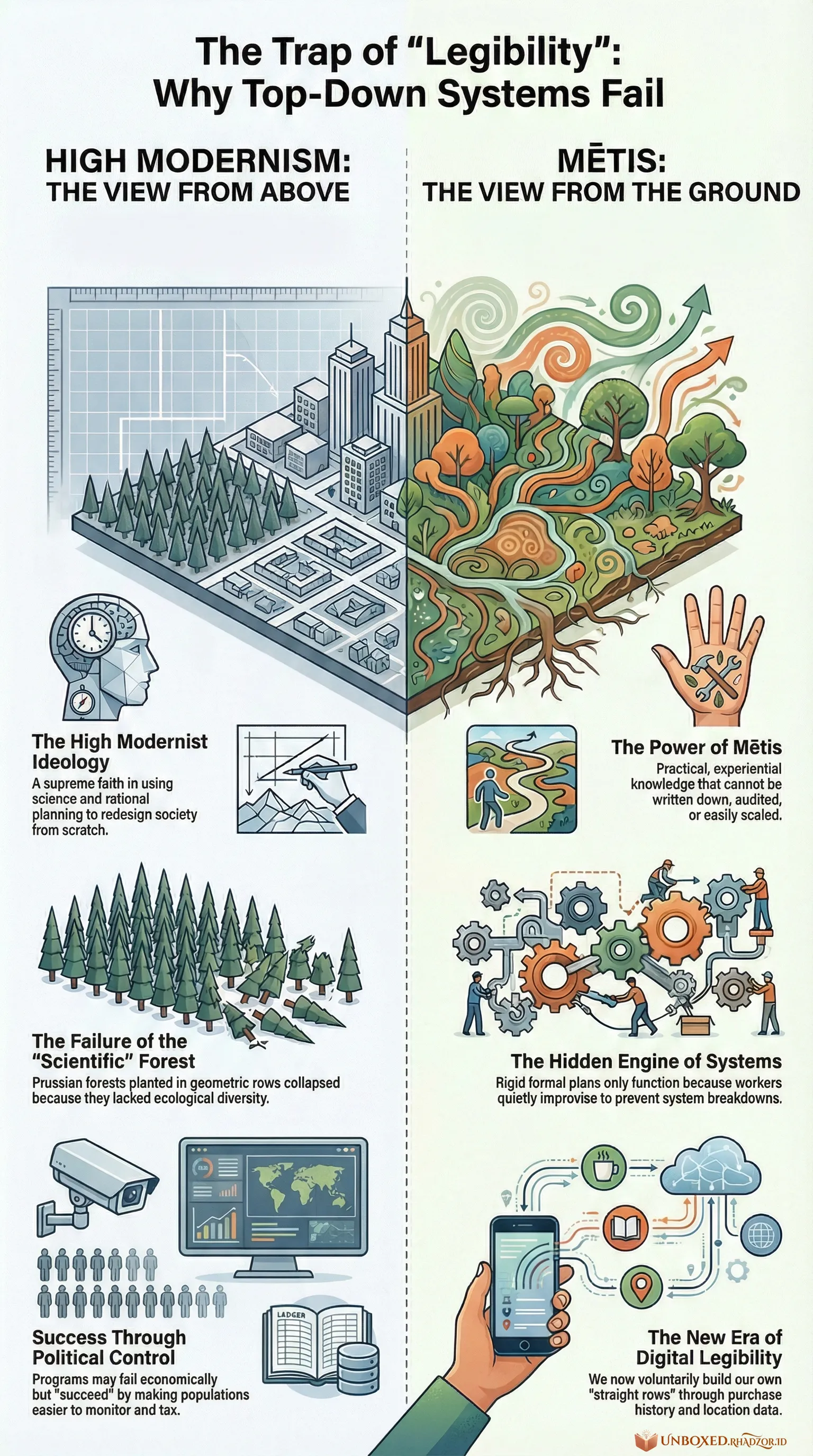
There's something worth interrogating in our obsession with legibility.

We celebrate complete databases, accurate maps, clean administrative systems. We assume that the more a government can *see* its citizens, the better it can serve them. James C. Scott's quiet, devastating argument is that this assumption deserves a harder look. The capacity of a state to read its population with precision isn't always a sign of progress. Sometimes, it's the precondition for catastrophe.

Scott opens with a forest — not a metaphor, an actual Prussian forest in the 18th century. To maximize timber output, the state planted a single species of tree in perfectly straight geometric rows. Immaculate from above. Administratively elegant. And within a few generations, the entire forest collapsed — overwhelmed by pests, stripped of nutrients, hollowed out because its ecosystem had been simplified into something that looked like order but couldn't sustain life. The Germans called it *Waldsterben*: forest death. Scott calls it the perfect illustration of what happens when someone becomes so fixated on a system that *appears* rational that they destroy the one that actually *works*.

What stopped me cold: nobody involved was malicious. The people who designed that forest weren't villains. They were just extremely confident they knew better.

---

That confidence has a name in this book: *high modernism*. An almost theological faith in science, rational planning, and the ability to redesign society from scratch. Scott describes its architects with a certain precision: *"The progenitors of such plans regarded themselves as far smarter and farseeing than they really were and, at the same time, regarded their subjects as far more stupid and incompetent than they really were."*

The line lands because we've all met this person. Not a dictator. Maybe a department head. Maybe a consultant with an 80-slide deck. Maybe someone in a meeting proposing a "new system" who has never spent a day doing the actual work they're proposing to optimize.

High modernism isn't exclusive to authoritarian regimes. It lives in urban planning offices, in international development agencies, in tech companies that sincerely believe an algorithm can replace the intuition of a market vendor who's been trading for two decades. The ideology doesn't need a strongman. It just needs institutional power and a population that can't push back.

---

The biggest paradox in the book isn't about plans that failed. It's about plans that succeeded — in the wrong direction.

Soviet collectivization and Tanzania's *ujamaa* villagization program were economic disasters. Harvests fell. Farmers suffered. Ecologies were wrecked. But Scott points to something uncomfortable: both programs succeeded *politically*. They broke rural independence, centralized control, and made previously "illegible" populations easy to monitor, tax, and discipline.

So whose definition of success are we using?

That question doesn't stay in the 20th century. It shows up every time you read a government report full of rising indicators. Rising by whose metrics? Progress toward whose vision? And who was never asked?

---

The concept I can't shake after closing this book is *mētis* — a Greek word for the practical, experiential knowledge that can't be written down or scaled. It lives in the farmer who knows when the soil needs rest. In the fisherman who reads weather from the color of the horizon, not a weather app. In the street vendor who navigates informal distribution networks that don't appear on any official map.

This knowledge is unauditable. It doesn't fit in a spreadsheet. It can't be transferred through a training manual. And for precisely those reasons, it is perpetually ignored by people designing systems from above.

Here's the part that actually bothers me: formal plans almost never function without *mētis*. The workers on the ground are always quietly improvising to keep the rigid system from breaking down. That improvisation is what makes the whole thing run. But it goes unrecorded, uncompensated — and occasionally, it gets criminalized.

---

We live in an era of legibility that would have been unimaginable to Scott's 18th-century state administrators. Location data, purchase history, browsing patterns, social graphs — the state and its corporate equivalents don't need a census team anymore. They read us continuously, automatically, and in real time.

Scott wrote this book before the smartphone existed. His thesis has only gotten sharper since.

The final irony — the one that's hardest to sit with — is that the most effective systems of population legibility aren't the ones imposed by force. They're the ones we built ourselves, voluntarily, because we thought they'd make life easier.

Perfectly straight rows of trees, planted with our own hands. Looks beautiful from above.