Most people, when they think about freedom, imagine its absence — a boot on a neck, a dissenter in a cell, a government that watches everything you do. The threat is always the state. Always the Leviathan.

What Acemoglu and Robinson argue — and what took me a while to sit with — is that this picture is only half right. The state can absolutely destroy freedom. But so can its absence. And the second part is the one we don't talk about enough.

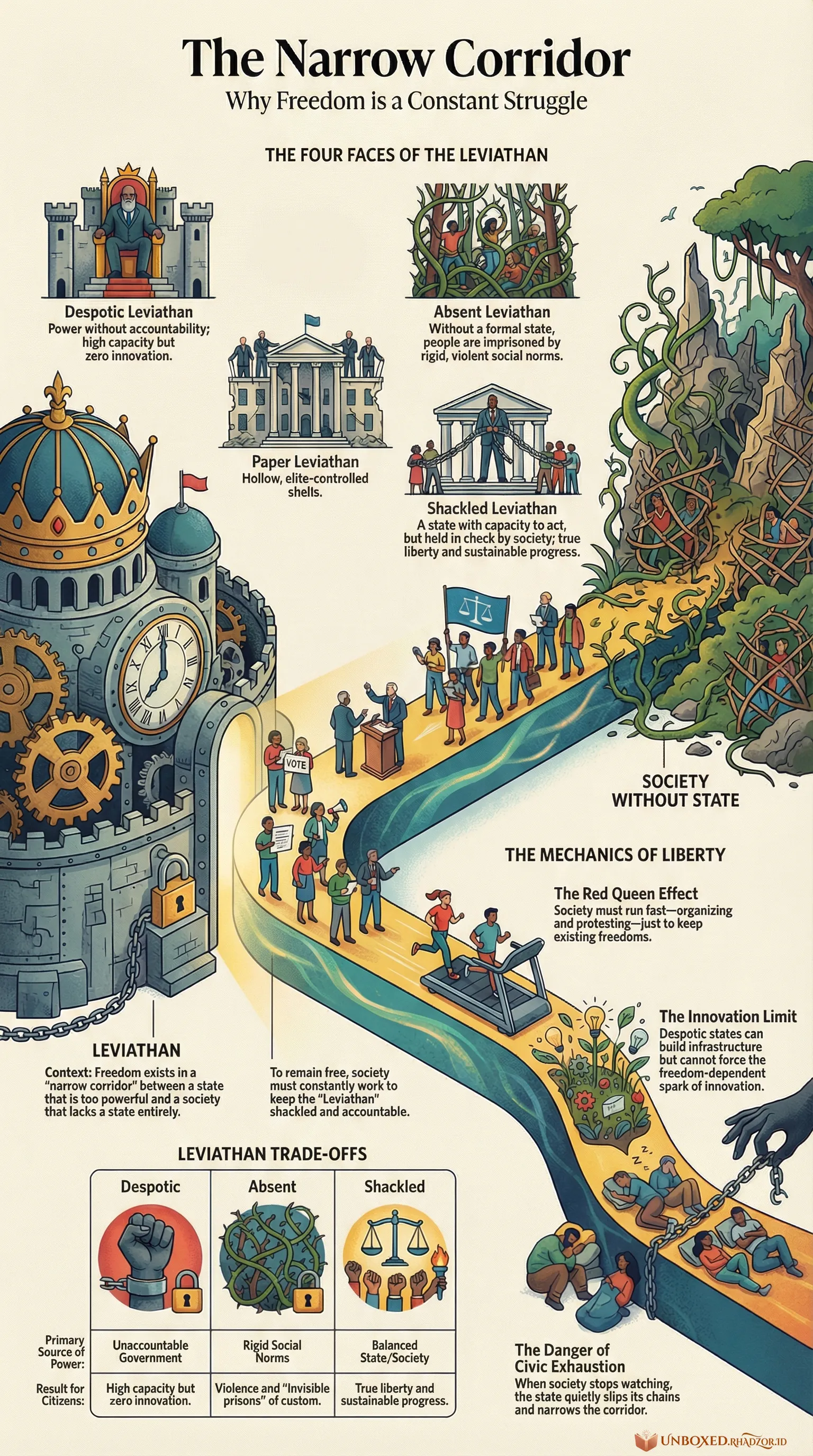
Freedom, it turns out, doesn't live in open fields. It lives in a narrow corridor.

---

Think of it less like a spectrum and more like a tightrope. On one side, the state grows too powerful and crushes everything beneath it. On the other, the state disappears and something older and often crueler fills the vacuum — tribal hierarchies, caste systems, social norms so rigid they function like invisible prisons. The corridor between these two falls is thin, and staying in it requires constant, exhausting effort from both sides.

To map this out, the authors describe four faces of the state — four ways this balance can go wrong, each with its own flavor of unfreedom.

The first is the one we recognize immediately: the **Despotic Leviathan**. A state with massive capacity and zero accountability. China, Nazi Germany, the Soviet Union. The government is everywhere, and its presence is the threat. It can build highways and launch satellites, but it cannot — structurally, fundamentally — produce innovation, because innovation requires the freedom to fail, and that's precisely what it extinguishes.

The second gets romanticized far too often: the **Absent Leviathan**. No formal authority, no courts, no police. People sometimes imagine this as freedom. It isn't. Without institutions to resolve disputes, communities don't become liberated — they become governed by something much older: norms, customs, caste, the judgment of village elders who cannot be appealed. You don't get arrested. You get destroyed by your neighbors, your family, sometimes your own mother.

The third is the rarest and the hardest to maintain: the **Shackled Leviathan**. A state that has real capacity — it can act, enforce, protect — but is kept in check by a society that stays organized, vocal, and relentlessly watchful. Western Europe and the United States, at their best, approximate this. The key word being *approximate*.

And the fourth is perhaps the most quietly devastating: the **Paper Leviathan**. A state that looks functional from the outside — flags, ministries, official letterheads — but is hollow at its core. Not because it failed to develop, but because the elites in charge *chose* not to build it. The logic is perverse but coherent: a functioning state mobilizes society, and a mobilized society demands accountability. Better, if you're at the top, to rule over organized dysfunction. Large parts of Latin America and Africa have been running this experiment for generations.

---

The part of this book that unsettled me most wasn't the chapter on China or the history of authoritarian collapse. It was the section on stateless societies.

There's a story here about Manoj and Babli — a young couple in India who were killed by their own families in 2007 for marrying across caste lines. India has a constitution. It has elections, a supreme court, democratic institutions. And yet the village council sided with the murderers. Because norms can be more powerful than written law, especially when the society around you has never been pulled out of the cage those norms create.

This is what the Absent Leviathan actually looks like in practice. Not romantic self-governance. A cage you can't see, enforced by the people closest to you.

*"To be free was to be a chicken among the hawks, a prey for the beast. Better to settle for voluntary servitude and give away your liberty."*

That line describes more of human history than most of us want to admit.

---

Then there's the American case, which might be the most structurally ironic example in the book.

The founders were so afraid of tyranny that they deliberately built a weak federal government — powers divided, checked, balanced against each other. Architecturally elegant. But that federal weakness created space for local despotism far more brutal than anything the founders claimed to fear: slavery, segregation, racial violence protected for centuries not by the federal state but by its deliberate absence from those matters.

And the second layer of irony: to fill that vacuum, the security apparatus grew in the shadows — the NSA, the CIA, intelligence agencies operating with minimal public oversight. The people most afraid of the Leviathan quietly built a new one underground.

*"Liberty needs the state and the laws. But it is not given by the state or the elites controlling it. It is taken by regular people, by society."*

That's not a feel-good line. That's a warning dressed up as inspiration.

---

The concept I can't stop thinking about is what the authors call the Red Queen Effect — borrowed from *Alice in Wonderland*, where you have to run as fast as you can just to stay in the same place. Society can never stop. It has to keep organizing, pushing back, demanding accountability — not because there's a finish line, but because stopping means losing ground.

Pause here for a moment: we are living through a period of mass civic exhaustion. Political fatigue is everywhere. The "nothing ever changes" sentiment is increasingly mainstream. And that's precisely when the corridor narrows — when a Shackled Leviathan starts quietly slipping its chains, not through a coup, but through the gradual, unremarkable disengagement of the people who were supposed to be watching.

Civic exhaustion isn't just a mood. According to this framework, it's a structural vulnerability.

---

The China section gives that vulnerability a concrete shape. Two hundred million facial recognition cameras. A social credit system that punishes not just what you say, but who you associate with. The book was written before generative AI became a household term — the infrastructure described here now has a much more powerful engine attached to it.

But here's the coldly reassuring part: despotism has structural limits. You can force people to build factories. You can't force them to innovate. Innovation requires experimentation, experimentation requires tolerance for failure, and tolerance for failure requires exactly the kind of freedom that authoritarian systems are designed to eliminate. The Soviet Union put humans in space. It couldn't make its citizens genuinely want to create something new.

---

I closed this book feeling something closer to discomfort than insight — which is probably the point.

Freedom isn't a destination. It's not something a good constitution gives you or a well-meaning leader hands down. It's the byproduct of a permanent, unresolved tension between power that wants to grow and people who refuse to stop paying attention.

The best protection against losing it isn't better laws or better politicians. It's ordinary people who haven't yet decided that running is no longer worth it.

Which is, admittedly, a lot to ask of people who are already tired.

And that's exactly the problem.