Here's something I keep coming back to: most people who follow a food prohibition can tell you *what* they don't eat. Very few can tell you *why* — and I don't mean the theological answer. I mean the one that predates it.

Marvin Harris's *Cows, Pigs, Wars, and Witches* is the kind of book that doesn't argue with your beliefs. It just quietly places them under a different kind of light. Harris is an anthropologist, and his project is uncomfortable in the best possible way: he goes looking for the material logic underneath the sacred. He covers a lot of ground — Indian cattle worship, tribal warfare, European witch hunts. But I want to stay focused on the pig. Partly because it's the most loaded food taboo in the country I live in, and partly because it's the one case where the gap between the official story and the operational history is widest.

---

The standard explanation has always been hygiene. Pigs are dirty. Pigs carry disease. Pigs wallow in their own filth.

It's a clean narrative. It just doesn't survive contact with the evidence.

Cows and sheep — both ritually clean, both celebrated — are perfectly capable of carrying anthrax and brucellosis. The Book of Exodus literally documents an anthrax outbreak that killed both humans and livestock. So if "carries disease" is the threshold for prohibition, the forbidden list should be considerably longer than it is.

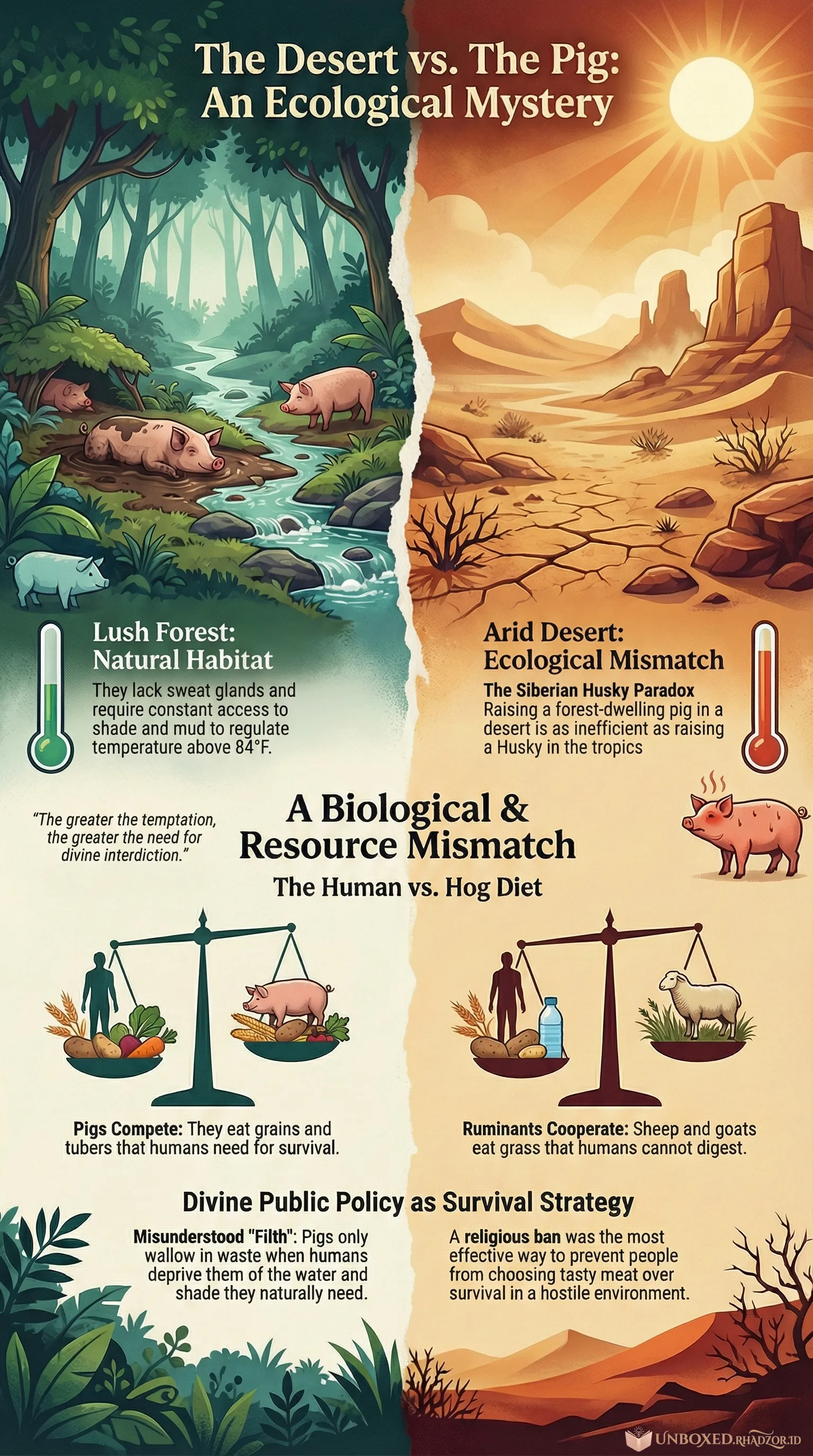
The "filth" argument collapses just as quickly. Pigs don't wallow in mud because they're morally degenerate. They do it because they have almost no sweat glands. Above 84°F, they need wet mud to regulate body temperature. In a hot, dry enclosure with no water access, they'll use whatever's available — including their own waste. That's not a character flaw. That's thermoregulation under duress. Put a human in a broken sauna with no exit and see how dignified the behavior gets.

---

The real answer is quieter and less dramatic. It lives in basic ecology.

The ancestors of the Semitic religions were nomadic pastoralists moving through the arid Middle East. Goats, sheep, cattle — these animals were metabolic miracles for that environment. They could convert cellulose and scrubland into meat, milk, and labor. Things humans can't digest became things humans could eat. Pigs offered no such conversion. They're forest animals. They eat grains, tubers, fruits — exactly what humans eat. In a landscape already struggling to sustain growing populations, raising pigs meant raising a direct competitor at your own dinner table.

Think of it this way. Imagine someone in the middle of a dry, sweltering coastal town deciding to keep a pack of Arctic sled dogs. Full Siberian Huskies. The dogs need air conditioning around the clock, imported specialty food, constant care. If an entire village adopted this practice during a water and food shortage, the village wouldn't last long. That's the ecological position of the pig in the ancient Middle East — not evil, not unclean, just catastrophically mismatched to its environment.

As forests shrank and populations grew, keeping pigs stopped being merely inefficient. It became a direct threat to communal survival.

---

Now here's the part that stopped me cold.

If pigs were naturally repulsive — if the meat tasted like nothing, or if they were difficult to catch and process — no one would need to be told twice. There'd be no rule required. The problem was the opposite. Pork is *good*. It's rich, fatty, satisfying. And Harris phrases it in a way I haven't been able to shake:

*"As in the case of the beef-eating taboo, the greater the temptation, the greater the need for divine interdiction... Pigs tasted good but it was too expensive to feed them and keep them cool."*

Sit with that for a moment.

The prohibition exists *because* the temptation was real. If no one wanted it, no one needed to forbid it. The intensity of the sacred rule is almost a direct measure of how badly people wanted the thing they were being told to avoid. We don't legislate against things that don't tempt us.

---

And since pre-industrial societies had no environmental ministries, no ecological research bodies, no evidence-based food policy — they had one tool that actually worked at scale: divine authority.

"God forbids it" was the most efficient public policy instrument ever invented. Zero administrative cost. Universal compliance across class and literacy levels. No need for enforcement bureaucracy — the enforcement was internal, wired into identity and fear of the afterlife. What looks like theology, from a certain angle, looks a lot like resource management wearing a different hat.

That's not cynicism. That's just how complex societies have always solved problems that require mass behavioral coordination.

---

What I find quietly unsettling — and I mean this without any judgment toward anyone's practice — is what happened next.

The ecological conditions that generated the prohibition are long gone. We have refrigeration. We have modern animal husbandry. Pigs can be raised in climates far more suited to them. The original crisis has been solved by technology. But the rule outlived its operational context. It migrated from being a survival mechanism to being an identity marker. Refusing a piece of meat today isn't protecting habitat carrying capacity. It's signaling community membership.

That's not inherently wrong. Identity is a powerful and legitimate human need. But there's a meaningful difference between doing something because you understand its history, and doing something because you never thought to ask.

---

Harris doesn't resolve any of this neatly. He just lights up a room that's been dark for a long time and lets you look around. The uncomfortable part isn't what you find. It's realizing how comfortable you'd gotten in the dark.

The most honest question his book leaves you with isn't "is this right or wrong?" It's simpler and harder than that:

*Do you actually know why you believe what you believe — or do you just know that you do?*

---

*That distinction, it turns out, matters more than most of us are willing to admit.*