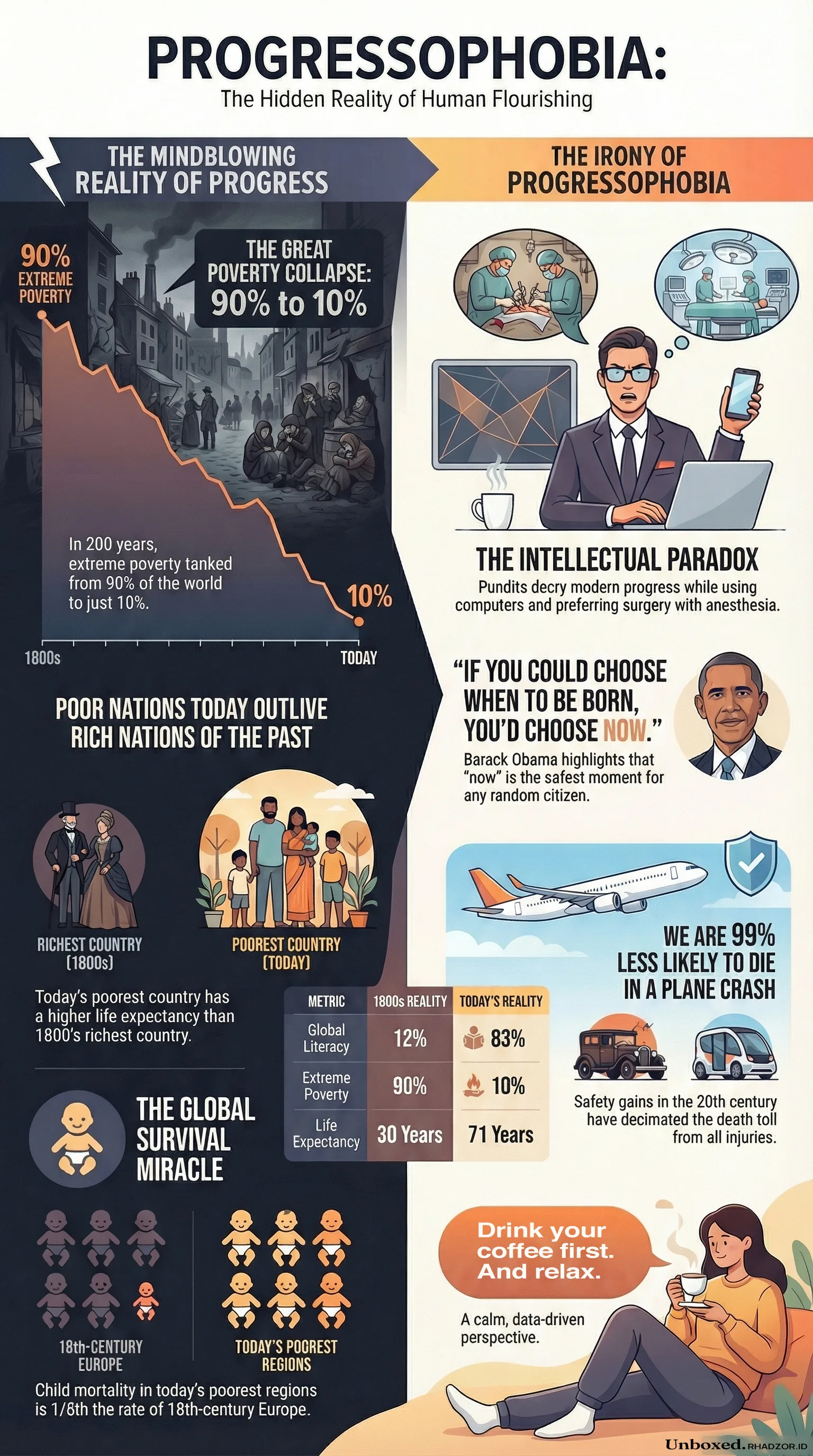
**Fair Warning:** If you're the kind of person who finds comfort in the narrative that the world is collapsing and we're all victims of a broken system—this piece might feel like an inconvenience. Not because I'm here to defend the status quo. But because data has a way of being deeply inconsiderate of our feelings.

---

Yesterday afternoon, sitting at my usual coffee spot somewhere in Semarang, I closed this brick of a book with a strange mix of emotions: relief and a quiet embarrassment. Relief because the world turned out to be less of a dumpster fire than I thought. Embarrassment because somewhere along the way, I had confused social awareness with chronic pessimism.

The book in question is Steven Pinker's *Enlightenment Now*—a volume that never pretends to be warm or easy. It's hundreds of pages of data, graphs, and arguments that essentially say one thing: empirically, humanity today sits at the healthiest, safest, most educated, and most prosperous point in our 300,000-year run as a species.

Eyebrows raised? Good. Let's get into it.

---

**First: You Just Spawned. And Yes, the Starting Conditions Are Brutal.**

This is the framing I keep coming back to whenever someone asks me why poverty exists.

Picture this: you boot up a survival game—*Rust*, *Don't Starve*, take your pick. The moment you spawn, you don't get a concrete shelter, a stocked fridge, or access to a walk-in clinic. You appear in the middle of nowhere, naked, hungry, and on the menu for whatever predator happens to be nearby. That's your default state.

Pinker asks us to look at human history through exactly this lens, reinforced by the Second Law of Thermodynamics—entropy. The universe, by default, drifts toward disorder and decay. There's no villain behind it. No shadowy system deliberately engineering misery. Poverty, disease, and famine aren't inventions—they're the starting conditions, the baseline of our species.

What's genuinely staggering is that we managed to build pockets of order inside all that entropy. Through institutions, trade, science, and reason, we've been grinding up from that brutal spawn point for centuries. Wealth isn't the natural state of things—wealth is the achievement. And that, I'd argue, deserves far more amazement than we typically give it credit for.

---

**Second: Why Our Brains Are Wired to Think Everything Is Getting Worse**

This is where cognitive psychology walks in and starts dismantling our collective illusions.

Two mental glitches are running simultaneously in almost every modern human brain. The first is *negativity bias*—an evolutionary holdover where threats feel far more vivid and sticky than good news. Our ancestors who missed one lurking predator didn't survive to pass on their genes. The ones who over-indexed on danger did. Missing a ripe piece of fruit just meant going to bed a little hungry.

The second is the *availability heuristic*—we estimate how common or significant something is based on how easily we can recall it. And what do we recall most easily? Whatever was most dramatic, most frequently reported, most emotionally charged.

The media, of course, runs precisely on these two cognitive vulnerabilities. News covers events—explosions, outbreaks, conflicts. No editor has ever greenlit the headline: "137,000 People Escaped Extreme Poverty Today" or "Child Mortality Down 60% Over Three Decades." These processes unfold slowly, quietly, undramatically—and therefore, commercially, they're worthless.

The result is what Pinker calls *progressophobia*: a psychological condition where we become unable—or unwilling—to believe that genuine progress exists, even when the data lays it out plainly in front of us.

---

**Third, and This One Stings a Bit: Who Hates Progress the Most?**

I need to sit with this section for a moment, because this is where the book's sharpest irony lives.

If you ask who produces the loudest, most consistent narrative that modernity is spiritually corrosive, capitalism is irredeemably evil, and civilization is sleepwalking off a cliff—the answer isn't people who are actually suffering in material poverty. The answer is intellectuals, academics, and cultural critics whose lives benefit most directly from the very progress they spend their careers denouncing.

Pinker puts it without much ceremony:

> *"Intellectuals hate progress. Intellectuals who call themselves 'progressive' really hate progress."*

They write essays about the toxicity of modern life on their latest laptops. They critique the pharmaceutical industry while quietly depending on the drugs keeping them alive. They fly across continents to attend conferences about civilization's existential crisis—an irony rich enough to age in a barrel.

There's an unspoken social contract in certain intellectual circles: pessimism signals depth and moral seriousness, while data-grounded optimism gets you labeled naïve, or worse, complicit. As if predicting collapse is prophetic, but pointing to a measurable decline in war deaths somehow makes you a corporate shill.

The test I'd apply: if you genuinely offered these same intellectuals a swap—their current life, versus an "authentic," pre-industrial, communal society of the past, complete with high child mortality, no antibiotics, limited female autonomy, and enforced tribal conformity—I'm fairly confident the answer would be a hard no before you finished the sentence.

---

**Closing Note: None of This Means Everything Is Fine**

One thing I want to be clear about before anyone misreads this: acknowledging that the world has become statistically, measurably better is not the same as claiming that everything is fine.

Climate change is real. Inequality still cuts deep. Armed conflict hasn't disappeared. But framing all of this as evidence that the entire system needs to be burned to the ground feels less like a solution and more like an emotional release dressed up as political philosophy.

Problems will always exist—entropy guarantees that much. What separates a civilization that advances from one that doesn't isn't the absence of problems. It's the capacity to solve them incrementally, evidence by evidence, without losing the plot somewhere between the outrage and the action.

We are, when you strip it all back, just a strange breed of primate that somehow figured out vaccines, legal systems, and fiber optic cables. That's not nothing. Appreciating it doesn't mean we stop caring—if anything, it should sharpen how we direct that care.

So before you scroll to the next headline and conclude that the end is near, maybe spend two minutes with a graph on global life expectancy over the last two centuries.

Data is rarely dramatic. But it's almost always more honest than how we feel.

*Finish your coffee first. Then panic.*