There are books you finish in a single night but that haunt your thinking for years afterward. *The Lessons of History* is one of them. Will and Ariel Durant spent decades writing *The Story of Civilization* across eleven dense volumes — then distilled it all into one slim book centered on the most fundamental question: *after everything, what have we actually learned from human history?*

The answers are not always comfortable. But that is precisely where the book earns its worth.

---

**Humans Are Part of Nature, Not an Exception to It**

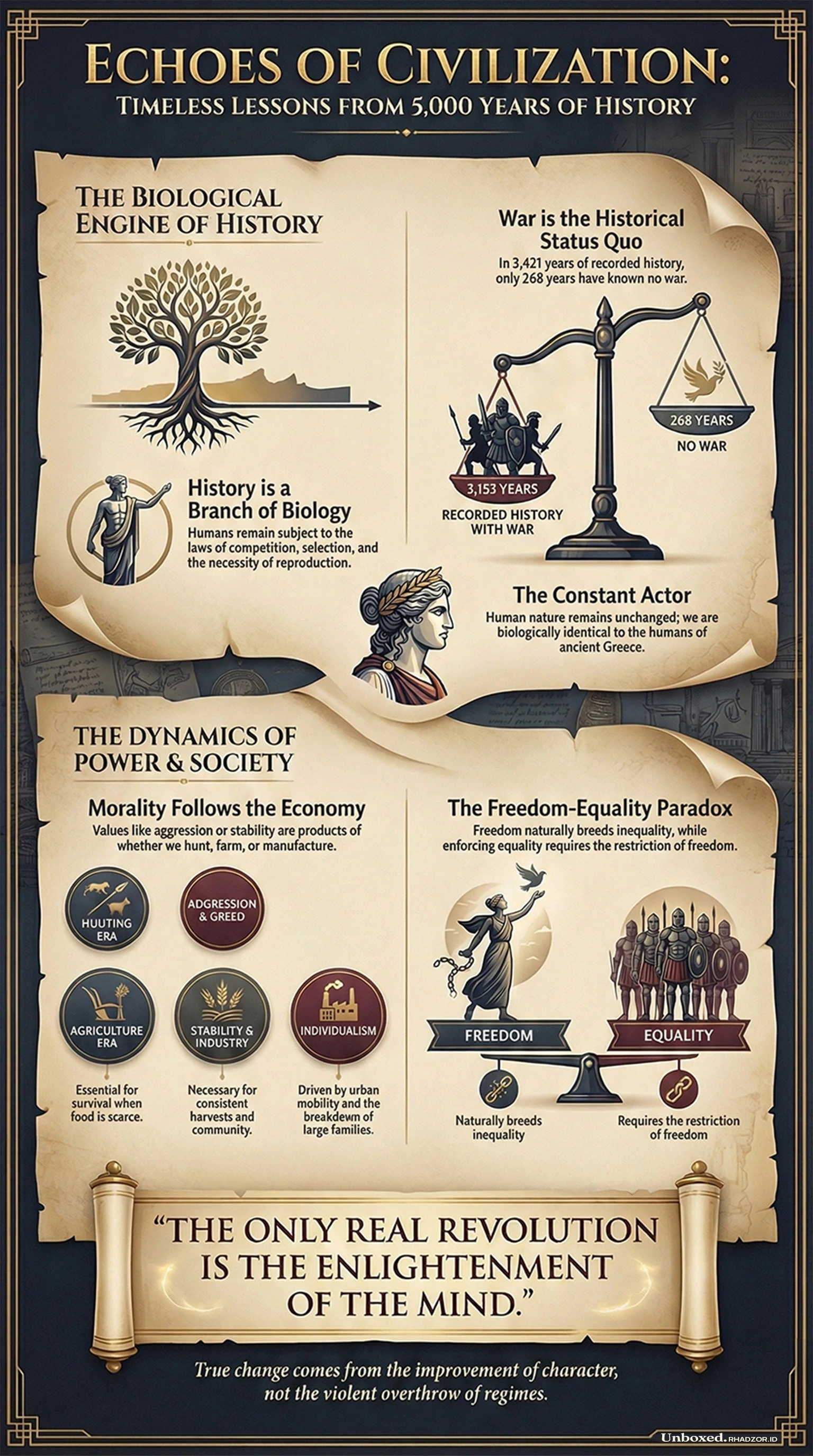
Durant's first lesson sounds deceptively simple, but its implications run deep: **the history of humanity is a branch of biology**. Before we talk about empires, revolutions, or ideologies, we need to reckon with the fact that we remain subject to the same laws governing every other living thing on this planet.

The first law is **competition**. The cooperation we celebrate — within families, communities, even nations — is, at its core, a strategy for competing more effectively against other groups. Peace within, rivalry without. This is not cynicism; it is a pattern that repeats across every era of recorded history.

The second law is **selection**. Human beings are not born equal — not in physical capacity, intelligence, or character. Nature does not recognize fairness in any moral sense; it only recognizes survival and reproduction.

The third law is the most frequently forgotten: **life must perpetuate itself**. Nature cares nothing for the quality of the individual — only for the continuity of the species. Throughout history, advanced civilizations with declining birth rates have repeatedly been absorbed by simpler but more fertile peoples. Rome felt it. Greece felt it. Many of the great civilizations we admire from a distance felt it too.

The uncomfortable conclusion: we can build skyscrapers and compose symphonies, but our fundamental instincts have not changed much since our ancestors lived in caves.

---

**Human Nature: The Constant Beneath All Change**

This is one of Durant's strongest theses — and one of the most frequently misunderstood.

When we see technology transform, cities expand, and social norms shift, we tend to assume that *people themselves* have changed along with everything else. Durant argues the opposite: **biologically and psychologically, an ancient Greek was essentially the same person as a human being today.**

What has evolved is not the person but the *setting* — economic systems, political institutions, technology. History is not the story of humanity growing wiser or kinder; it is the story of the same actors playing the same characters on an endlessly changing stage.

The implication is striking: if you want to understand today's leaders or conflicts, you do not necessarily need the latest political analysis. Reading Thucydides, the story of Julius Caesar, or the court intrigues of the Ming Dynasty will often take you further. The script has already been written — many times over.

---

**Morality Is Not Eternal Truth — It Is a Product of Economics**

This is the most mind-bending section of the book, and also the easiest to misread if you move through it too quickly.

Durant is not saying morality does not matter. He is saying that *what any given society considers "good" or "bad" is largely determined by the economic system that sustains it.*

Consider humans in the age of hunting. Aggression, voracity — eating as much as possible because tomorrow's meal was never guaranteed — and the willingness to kill in order to survive were not sins. They were *virtues that kept people alive*. The hesitant man did not last long.

Then came the age of agriculture. Suddenly, stable communities became the foundation of survival. Excess aggression now threatened the harvest and the harmony of the village. The traits that once saved lives became social liabilities — and religion, custom, and law arrived to tame them.

Then came industrialization. Children who had been economic assets on the farm became financial burdens in the city. Marriage was postponed. Social mobility severed the bonds of extended families. Individual freedom eroded traditional authority. Morality shifted again — not because people changed, but because the *material conditions* that shaped morality had changed beneath them.

A question worth sitting with: what kind of morality is the age of artificial intelligence quietly building right now?

---

**Equality and Freedom Cannot Fully Coexist**

Perhaps no argument Durant makes is more provocative than this one.

We live in an era that wants everything at once — complete freedom *and* complete equality. Durant, with cool and unsentimental clarity, argues that **nature itself makes these two ideals impossible to fully reconcile.**

The logic is straightforward. If you allow people complete freedom, those who are more talented, more driven, and more fortunate will continuously accumulate advantage. Inequality is not an aberration of a free system — it is its *natural outcome*. Wealth has concentrated in the hands of a small minority in virtually every era of human history, under virtually every kind of economic arrangement.

Conversely, if you want to enforce equality, you *must* restrict freedom. Someone has to decide who gets what — and that decision requires power, which history shows has a way of becoming authoritarian.

Durant sees the economy as a heartbeat: wealth concentrates upward (systole), reaches a breaking point, and is then redistributed (diastole). The redistribution can be peaceful — through progressive taxation, legal reform, and social policy. Or it can be violent — through revolution, civil war, and the collapse of the existing order.

There is no third option. History has always chosen one or the other.

---

**Revolution Changes Faces, Not the Character of Power**

On the subject of revolution — Durant has a message that will disappoint the idealists.

Violent revolutions, with very few exceptions, do not genuinely transform power structures. What changes is only *who* sits at the top. The leaders of revolutions, once they seize power, rapidly adopt the same instincts as the regimes they overthrew: consolidate control, protect the inner circle, suppress dissent.

The French Revolution produced Napoleon. The Russian Revolution produced Stalin. This is not coincidence — it is pattern.

Durant put it plainly:

> *"The only real revolution is in the enlightenment of the mind and the improvement of character. The only real revolutionists are philosophers and saints."*

The changes that truly endure, he argues, are not the ones born from violence — they are the ones that emerge from a slow, deep transformation in how human beings think.

---

**War Is the Default, Not the Exception**

One figure Durant offers will stay with you long after the book is closed:

In 3,421 years of recorded human history, only **268 were free of war**.

Less than eight percent.

For Durant, war is not a failure of civilization — it is civilization's most honest expression of the competition between groups we have been discussing from the beginning. Nations "feed" and survive in ways that are not so different from organisms competing within a natural ecosystem. Prolonged peace is not the historical norm; it is an anomaly that requires extraordinary, continuous effort to maintain.

---

**So Has Humanity Actually Progressed?**

After all of this — after the unflinching portraits of inequality, war, and cyclical power — Durant closes the book with an honest question: *is there any real progress?*

His answer is neither simple nor despairing.

Progress cannot be measured in happiness, because an ignorant child is often more joyful than a wise adult. Technology is morally neutral — the same knowledge that heals can destroy. Scientific advancement does not automatically mean moral advancement.

But progress is real in one specific sense: **our accumulated social inheritance keeps growing**. Each generation inherits not only the genes of its ancestors, but also the knowledge, art, law, and hard-won wisdom built up over thousands of years. Civilization does not die — it migrates, transforms, and is passed forward through education.

In this sense, history is not merely a chamber of horrors filled with humanity's repeated mistakes. It is an enormous library where we can learn — not to escape the future, but to face it with clearer, more honest eyes.

---

*And perhaps, that is already enough.*