**A disclaimer first:** I don't rattle easily. Bold claims, grand narratives, civilization-scale arguments — I've heard enough of them to have developed a fairly decent filter. But every once in a while, a book manages to do something genuinely unsettling: it makes you stop, put down your drink, and quietly ask yourself, *"Wait. Have I been living inside a story this whole time?"*

Not deceived by another person. Deceived by a constructed reality you never thought to question — because it was always just... there.

Welcome to **Unboxed**. This isn't a review. Think of it more as notes from someone who made the mistake of reading Harari's *Sapiens* and couldn't stop thinking afterward.

---

**First: Why can we build cities, and chimps can't?**

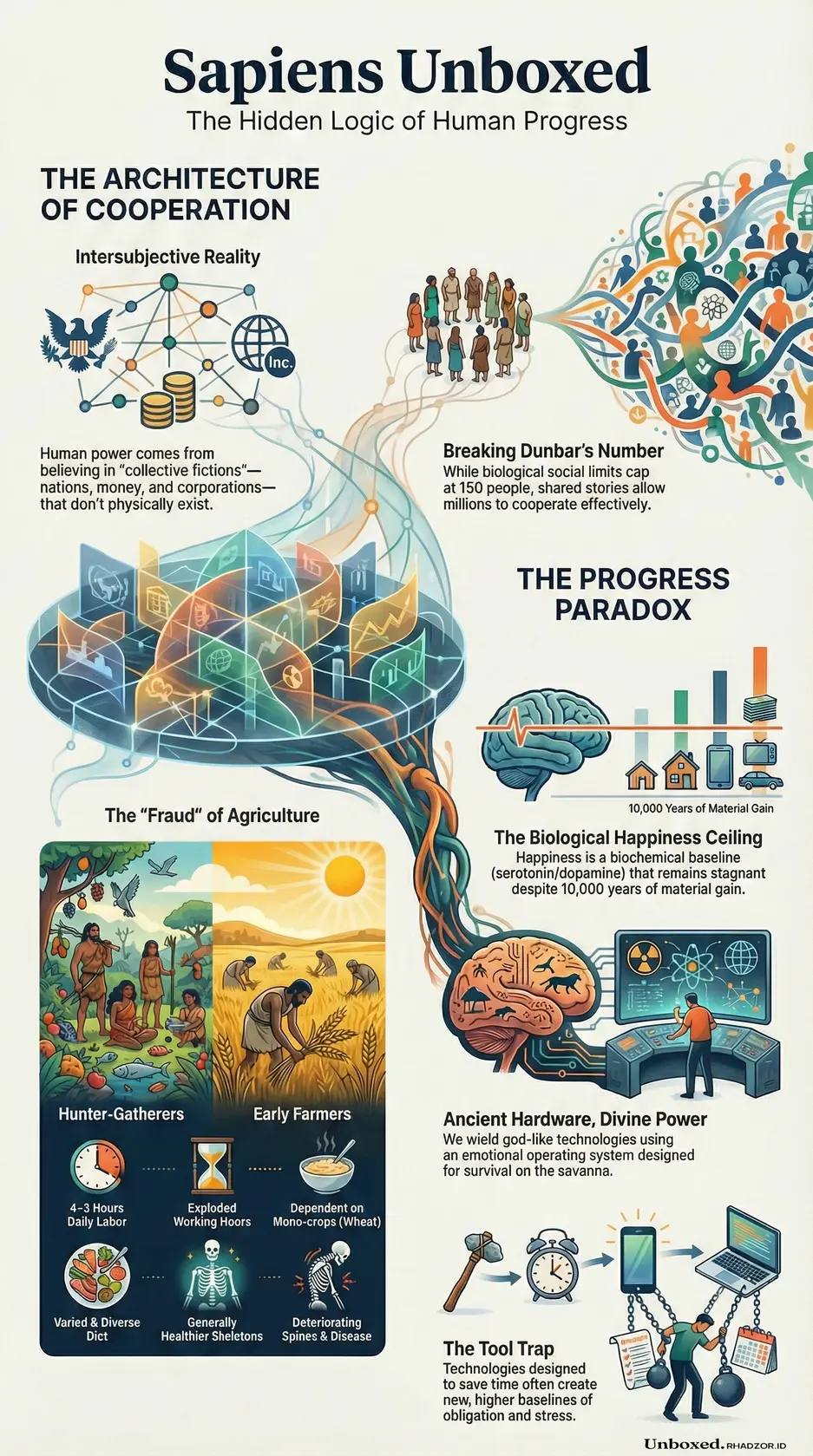
Not because we're smarter as individuals. Not because our hands are more capable. The answer, stripped down to its core, comes from one peculiar ability that no other species seems to possess: *we can collectively believe in things that don't exist.*

Here's a useful frame. The human brain, biologically, can only maintain meaningful social relationships with roughly 150 people — Dunbar's Number, if you want to put a name to it. Beyond that threshold, our social networks start leaking. And yet, we've managed to build empires with millions of subjects, multinational corporations with hundreds of thousands of employees, and ideological movements that span continents. How?

**Collective fiction.**

Nations, money, religion, corporations — none of these things exist as physical objects in the universe. A hundred-dollar bill is worthless the moment enough people collectively decide it's just paper. A limited liability company has no legal personality without a shared belief system propping it up. Harari calls this *intersubjective reality* — something that becomes real not because it has physical substance, but because enough people simultaneously agree that it does.

That's what separates us from chimpanzees. Not raw cognitive firepower, but the ability to co-author a story together — and then live inside it as though the story were concrete, touchable, and permanent.

Slightly unsettling? Yes. Evolutionarily brilliant? Also yes.

---

**Second — and this is the sharpest irony in the entire book.**

We've always been told that the Agricultural Revolution was one of humanity's great leaps forward. From nomadic to settled. From hunting to farming. From uncertainty to control. Progress, right?

Harari calmly dismantles that narrative.

He calls it *"history's biggest fraud."* And once he lays out the argument, it's genuinely hard to push back.

Consider it from this angle. Hunter-gatherers worked an average of four to five hours a day to meet their basic needs. Their diet was varied, their lives were mobile, and — this is the part that tends to catch people off guard — their skeletal remains show bodies that were generally *healthier* than those of early farmers. Then agriculture arrived. The result? Working hours exploded. Diets collapsed into near-total dependence on a handful of crops — wheat, wheat, and more wheat. Infectious disease spread rapidly as people crowded together with livestock. And human spines started deteriorating from a lifetime of bending over fields.

Individual quality of life, by most objective measures, *went down*.

And yet, collectively, human populations exploded — because agriculture produced the caloric surplus needed to sustain far more mouths. Evolution doesn't care whether your life is enjoyable. Evolution runs one calculation: how many offspring survive?

Which brings me to what I think is the most elegant reframe in the book. We assume we domesticated wheat. But looking at it through the cold logic of evolutionary success — wheat domesticated *us*. Humans became the unwitting distribution agents for its DNA across the entire planet, in exchange for a life that was, by most measures, harder than the one we'd left behind.

And the pattern repeats, if you're paying attention. Email was invented to make communication more efficient. Now there's an unspoken expectation that you'll respond at eleven at night. The tools we build to free ourselves have a quiet tendency to redefine what's considered the new baseline of obligation — and we rarely notice the transition until it's already happened.

---

**Third: Happiness, it turns out, has a biological ceiling.**

This is the part that had me staring at the ceiling longer than I'd like to admit.

If you pull the common thread running through all of human civilization — the pyramids, the internet, legal systems, declarations of rights — it eventually leads to the same destination: a better life. A happier one.

But Harari asks a question that's easy to sidestep and hard to answer honestly: *has any of it actually made us happier?*

Biochemically, happiness isn't a function of the size of your house or the stability of your income. It's about hormonal fluctuation — serotonin, dopamine, oxytocin. And our biological systems come with a kind of internal thermostat, a baseline that keeps pulling us back to neutral regardless of external circumstances. Get promoted? You feel good for a few weeks, then return to default. Lose a job? You feel awful for a while, then — in most cases — drift back toward the same baseline.

Which means that a senior executive in a high-rise apartment and a 12th-century farmer who just finished building his mud house likely experienced moments of achievement with roughly equivalent hormonal intensity. The felt sense of satisfaction, at the moment of their respective wins, was probably not that different.

Ten thousand years of extraordinary material progress, and it doesn't appear to have produced a proportional increase in human happiness. We've been running hard, but the finish line keeps moving.

Harari ends this line of thinking with a sentence that, I'll be honest, landed harder than I expected:

> *"Is there anything more dangerous than dissatisfied and irresponsible gods who don't know what they want?"*

We're a species that has acquired something close to divine power — genetic engineering, nuclear fission, the ability to orbit our own planet — while still running on an emotional operating system designed for survival on the African savanna. The hardware is ancient. The ambitions are not.

---

**Pragmatic Conclusion**

I'm not offering solutions here, because there aren't any clean ones.

What I can offer is a single, grounded observation: the civilization we've come to think of as "progress" is a process riddled with trade-offs that nobody consciously agreed to. Our ancestors didn't sit down and choose agriculture. We didn't vote to organize our entire lives around collective fictions. We were born into these systems and inherited them as given reality — as just the way things are.

Maybe the most realistic response isn't to try to exit the system — that's not really on the table. It's to be more honest about what game we're actually playing. And to hold our species with a little more humility, given that after all this time, we still don't fully know what we want.

Tomorrow you'll probably sit in traffic, scroll further than you intended, and feel vaguely anxious about something you won't remember in three years. That's not personal failure. That's just what it looks like to be a *Homo sapiens* — smart enough to build a civilization, not quite wise enough to fully reckon with what we've built.

Myself included. My tea's gone cold again.