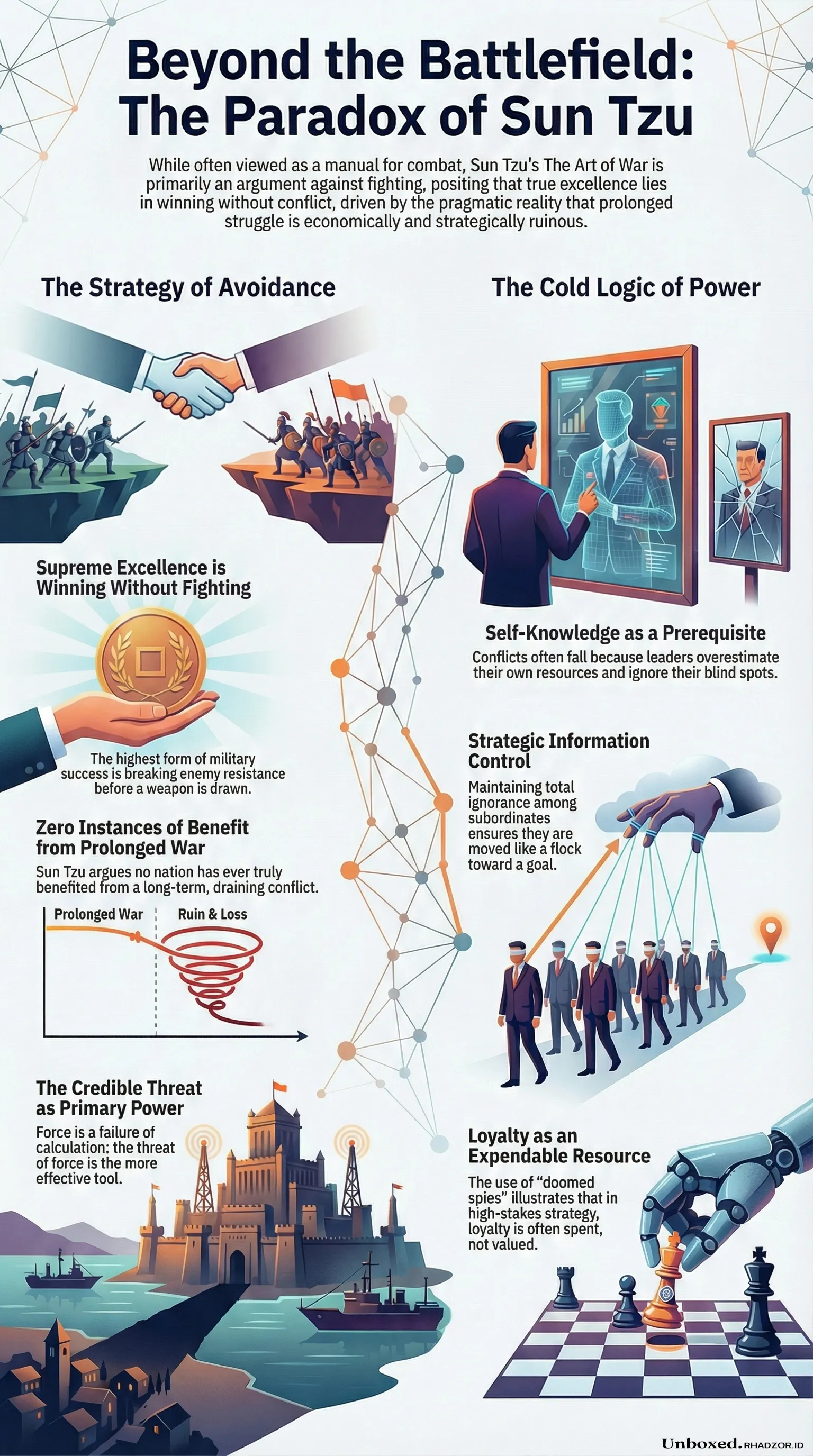
Here's the thing nobody tells you about *The Art of War*: the whole book is essentially an argument against fighting.

Which is a strange thing to discover in a military manual written by a general, for generals, that has been used as a tactical reference for two and a half millennia. But there it is. Sun Tzu's central thesis — buried under all the chapters about terrain and troop movement — is that the highest form of military excellence is making your enemy surrender before a single weapon is drawn. *"Supreme excellence consists in breaking the enemy's resistance without fighting."*

Not winning battles. Preventing them.

Think of it like this: the most effective pressure a country can exert isn't necessarily its military — it's the credible *threat* of its military. The moment you actually have to use force, something has already gone wrong in the strategic calculation. Sun Tzu understood this in 500 BC. We're still relearning it every decade in foreign policy.

---

What stayed with me longest, though, wasn't the grand strategy. It was the colder, quieter parts.

Sun Tzu instructs commanders to keep their own soldiers in deliberate ignorance — to move them like a flock that doesn't need to know its destination. And then there's the concept of *doomed spies*: agents who are intentionally fed false information by their own commanders, then sent into enemy territory, where the lie gets discovered and the spy gets killed. Their death was always part of the plan. They just weren't told.

That's not loyalty as a value. That's loyalty as a resource to be spent.

And I kept thinking — we don't need to go back 2,500 years to find this logic. It shows up in companies that keep restructuring plans hidden from employees until the last possible moment. In governments that manage public narratives with selectively released data. In political campaigns that run entirely different messaging for different audience segments without any of them knowing. *"Keep them in total ignorance"* was written as a military instruction. It reads like a description of how institutions operate today.

---

*"If you know the enemy and know yourself, you need not fear the result of a hundred battles."*

Everyone quotes this. It's on coffee mugs. LinkedIn posts. Motivational decks. Which is unfortunate, because it's actually worth sitting with seriously.

Stop for a second: how many conflicts — between nations, companies, or just two people in a meeting — fall apart not because someone misjudged their opponent, but because they misjudged themselves? Overestimated their resources. Underestimated their own blind spots. Mistook confidence for capability.

Sun Tzu places self-knowledge first. Not as a philosophical nicety — as a strategic prerequisite. Most people skip that part.

---

There's another line that doesn't get quoted nearly enough: *"There is no instance of a country having benefited from prolonged warfare."* No instance. Not a hedge. Not a caveat. An absolute.

He didn't write that as a moral position. Sun Tzu was not in the business of moral positions. He wrote it as a pragmatic observation — war is expensive, it drains resources, it weakens states even when they win, and therefore speed and decisiveness aren't just tactically smart, they're economically necessary.

Here's the irony: the most structurally anti-war argument in recorded history might not have come from a peace activist or a humanist philosopher. It came from a military general writing a technical manual. The people most incentivized to glorify war were often the first to understand why you shouldn't start one you can't finish fast.

---

I closed this book not with a list of tactics I could apply somewhere, but with a quieter and slightly unsettling recognition: the logic of power — military, corporate, political — has been remarkably consistent across history. Not because of conspiracy. But because humans, placed in high-stakes competitive situations, tend to converge on the same patterns regardless of the century they're operating in.

Sun Tzu just had the clarity — and the frankness — to write it down plainly.

Maybe that's why it's still being read 2,500 years later. Not because it's profound. Because it's familiar. Uncomfortably so.