There's a particular kind of discomfort that comes not from reading something wrong, but from reading something _accurate_.

Machiavelli delivers that feeling on almost every page.

_The Prince_ is not a manual for villains. It's closer to a field report from someone who spent years watching how power actually works — not how graduation speeches say it should work, not how leadership books packaged for airport bookstores describe it, but how it _actually_ functions when the stakes are real and the options are bad.

And the reason it still lands, five hundred years later, is because human nature didn't get the memo that we've evolved.

---

The observation that stopped me cold wasn't about politics. It was this:

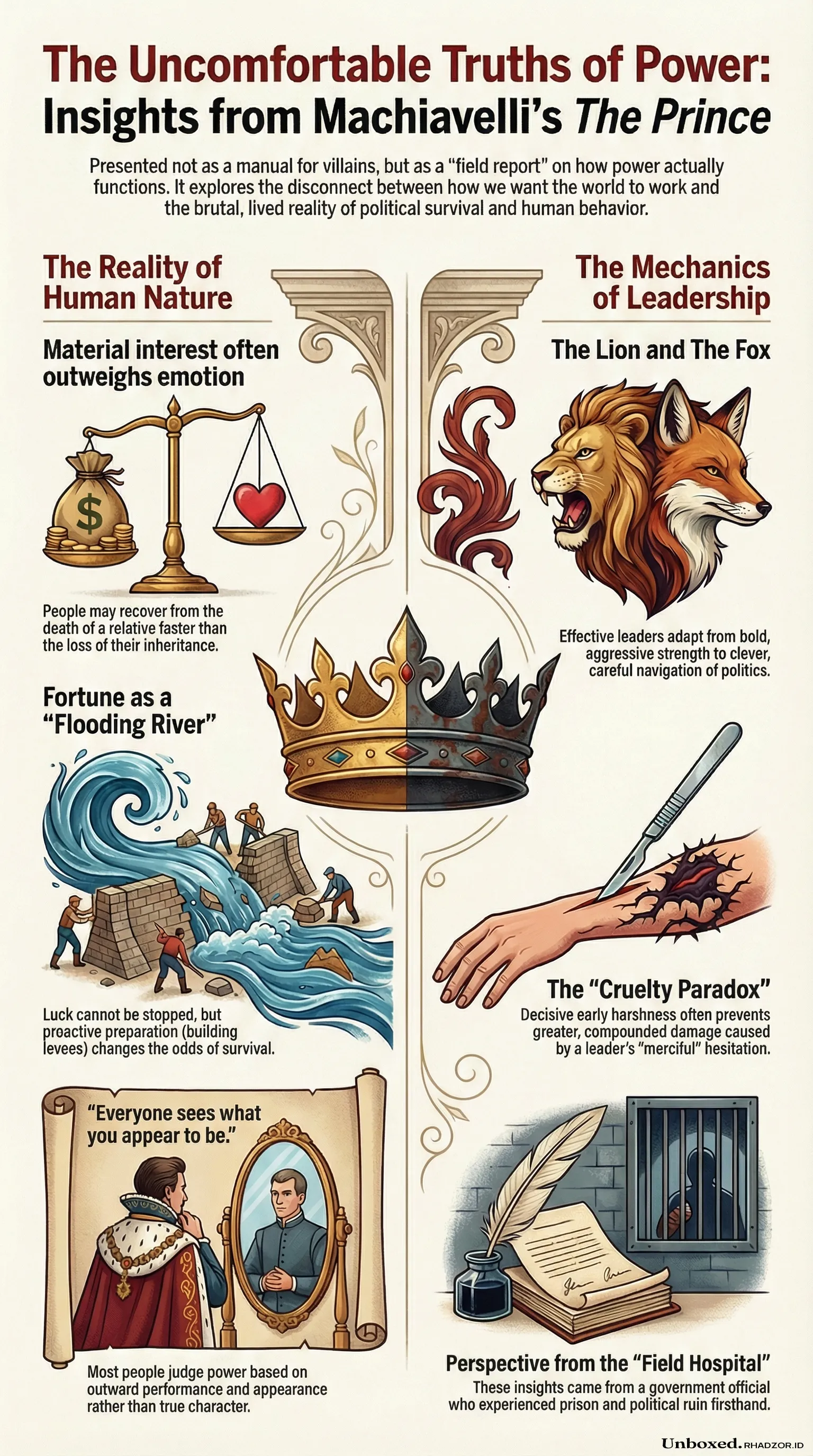
_"Men will sooner forget the death of their father than the loss of their inheritance."_

Sit with that for a second.

It's a brutal claim. It's also the kind of thing you recognize the moment you've seen enough family disputes, enough inheritance fights, enough people who would cry at a funeral and then spend the next three years in court over a house. Machiavelli wasn't moralizing about this. He was just noting it — the way a biologist notes behavior in a field study, without needing it to mean something larger about the universe.

That's what makes this book different from most writing about leadership: it never asks you to feel good about what it's describing.

---

The lion and the fox framework sounds like something from an old fable, but apply it to anything modern and it holds up embarrassingly well. A founder who was all lion in year one — aggressive, bold, burning bridges to move fast — who quietly becomes fox by year three, navigating board politics and carefully managing perception. A politician who campaigned on disruption and then, once in office, became fluent in the language of compromise.

We tend to read those shifts as betrayal. Machiavelli would read them as adaptation.

That doesn't make it comfortable. It just makes it legible.

---

The paradox I kept turning over was the cruelty one — and it's worth slowing down here, because it's easy to misread.

Machiavelli doesn't celebrate cruelty. He makes a colder argument: that a leader who avoids all hard decisions in order to appear merciful often causes more total damage than one who acts decisively early. The soft leader lets small problems compound. Resentments build. Eventually things break — and when they break, they break wide. More people get hurt. The damage is just distributed over time, which makes it easier to ignore.

The decisive leader looks harsh. The damage is visible and immediate. But the math, if you're counting correctly, might look different than it first appears.

This is not an argument for brutality. It's a question about how we measure harm — and whether we're measuring it honestly, or just measuring what's in front of us.

---

Worth pausing here for a moment.

Machiavelli wasn't writing from a philosophy department. He was a mid-level government official in Florence who got fired after a coup, thrown in prison, and tortured. _The Prince_ was written by someone who had personally watched what happens when power is handled naively — not as an abstract thought experiment, but as a lived consequence.

That context matters. It's the difference between someone theorizing about war from a library and someone writing about it from a field hospital.

---

His metaphor for fortune is one of the most honest things in the book: luck is like a flooding river. You can't stop it. But if you've built levees before the rain comes, you survive it differently than someone who hasn't. The flood doesn't care about your plans or your intentions. It just moves.

This is not motivational. It's almost the opposite — a reminder that preparation doesn't guarantee survival, it just changes the odds. And the people who spend their lives assuming the flood won't come are the ones most completely destroyed when it does.

---

What I walked away with wasn't a framework or a lesson. It was more like an uncomfortable recalibration.

_"Everyone sees what you appear to be, few really know what you are."_

Machiavelli wrote that as advice for a prince. But read it from the other side — from the position of the governed, the managed, the led — and it stops being strategy. It becomes a description of how most of us form our judgments about the people who hold power over us.

We evaluate performance. We evaluate appearance. We tell ourselves we're reading character.

The book doesn't tell you what to do with that realization. It just leaves you holding it.

Which, honestly, feels about right for a book written by someone who died without ever recovering the political career he lost — still sharp, still watching, still taking notes on a world that never quite matched the version he thought he understood.