Here's something that took me a while to sit with.

Every time there's turbulence — in markets, in politics, in everyday life — our instinct is to smooth it out. Stabilize. Intervene. Fix. We've built entire institutions around this reflex. Central banks exist to iron out economic volatility. Helicopter parents exist to iron out childhood difficulty. PR teams exist to iron out reputational mess. We treat disorder like a bug in the system, something to be patched.

Nassim Taleb's _Antifragile_ spends about 500 pages making the case that this instinct — however well-intentioned — might be one of the most dangerous things about modern civilization.

Not the crises themselves. The prevention of small crises, which quietly stockpiles the conditions for catastrophic ones.

---

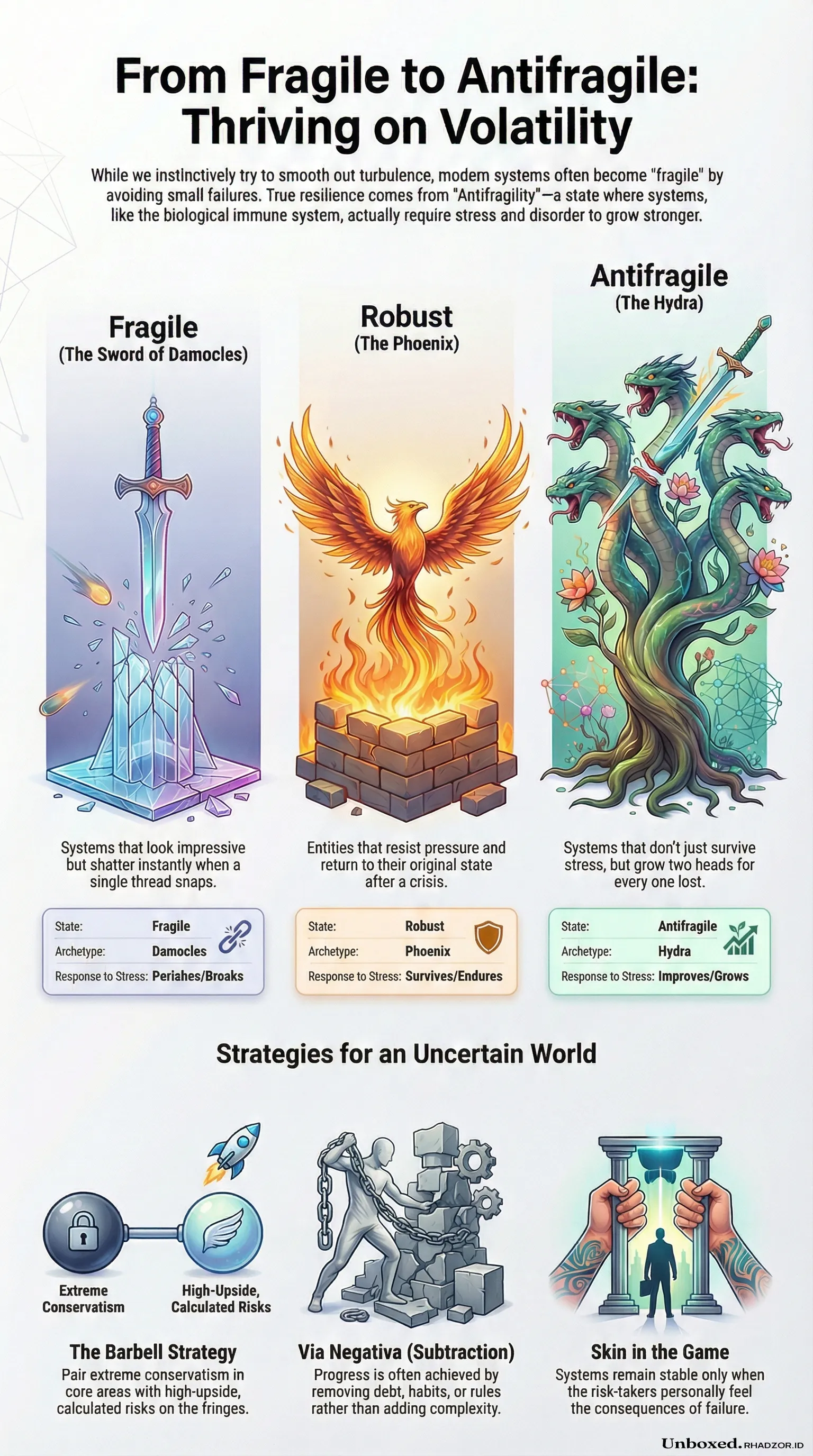
The concept at the center of the book is deceptively simple. Most of us assume the opposite of fragile is robust — something that doesn't break under pressure. But robust just means it survives. Taleb introduces a third category that didn't have a name before: _antifragile_. Things that don't just survive stress, but actually improve because of it.

His mythological shorthand is useful here. Fragile is the Sword of Damocles — looks impressive until one thread snaps and it kills you. Robust is the Phoenix — dies and comes back exactly the same. Antifragile is the Hydra — cut one head, two grow back.

Most of what we've built — institutions, financial systems, political structures — looks a lot more like Damocles than Hydra. Which is fine, until it isn't.

---

Pause here for a second.

If a system can only learn through failure, then shielding it from failure doesn't protect it — it lobotomizes it. You're not building resilience. You're removing the only mechanism through which resilience develops. That's not a conservative or liberal argument. That's just how complex adaptive systems work, whether we're talking about immune systems, forests, economies, or people.

This is where Taleb introduces the concept of _iatrogenics_ — harm caused by the healer. Doctors who over-prescribe. Governments that over-intervene. Parents who over-protect. All well-meaning. All capable of producing outcomes that are worse than doing nothing.

We live in a culture where _doing something_ always feels more responsible than _doing nothing_. Taleb's uncomfortable suggestion is that the most sophisticated thing you can do sometimes is get out of the way.

---

There's a practical framework buried in here too — what he calls the _barbell strategy_. Forget the middle ground that feels safe but is actually the most deceptive position. Instead, go to both extremes: be extremely conservative with most of what matters to you, and take calculated asymmetric risks on a smaller portion — where your downside is capped but your upside isn't.

It sounds like investment advice, and it is. But it's also a way of structuring decisions about career, relationships, time. The logic extends further than finance.

What I found more compelling, honestly, is the _via negativa_ argument — the idea that progress isn't always about adding. Sometimes the smartest move is subtraction. Cut the debt. Drop the habit. Remove the rule that's slowing everything down. Time, Taleb argues, is the best filter for fragility. What survives long enough, probably deserves to.

---

The part that genuinely unsettled me isn't the theory. It's the mirror it holds up.

We've spent decades being governed, advised, and managed by people with no skin in the game. Bankers gambling with other people's money. Policymakers who retire before their policies fully unravel. Consultants who give the advice, collect the fee, and disappear before the consequences land. They capture the upside of volatility while the downside gets distributed to everyone else.

An antifragile system, Taleb argues, requires one basic condition: the people who take the risks must feel the risks.

Without that, what we have isn't a stable system. It's a fragile system that _looks_ stable — which is, quietly, the most dangerous thing it can be.

---

_"Wind extinguishes a candle and energizes a fire."_

That line stayed with me longer than most things I've read this year. Not because it's poetic — because it's precise. It describes something true about biology, history, institutions, and people all at once.

The question it leaves you with isn't how to avoid the wind. It's whether you've been building candles or building fires — and whether you've been honest with yourself about which one.

Most of us, probably, haven't been.

And that's not a comfortable place to end up. But it's an accurate one.

---

_Written for Unboxed — not a review, just thoughts that didn't quiet down after the last page._