There's a specific kind of discomfort that comes not from not understanding something, but from understanding it too well.

That's what reading Schelling felt like.

At some point in the middle of this book, I put it down and just sat there. Because he had just finished explaining why the person with *fewer options* often holds more power at the negotiating table than the person with everything to offer. And the worst part? Once you see it, you can't unsee it anywhere.

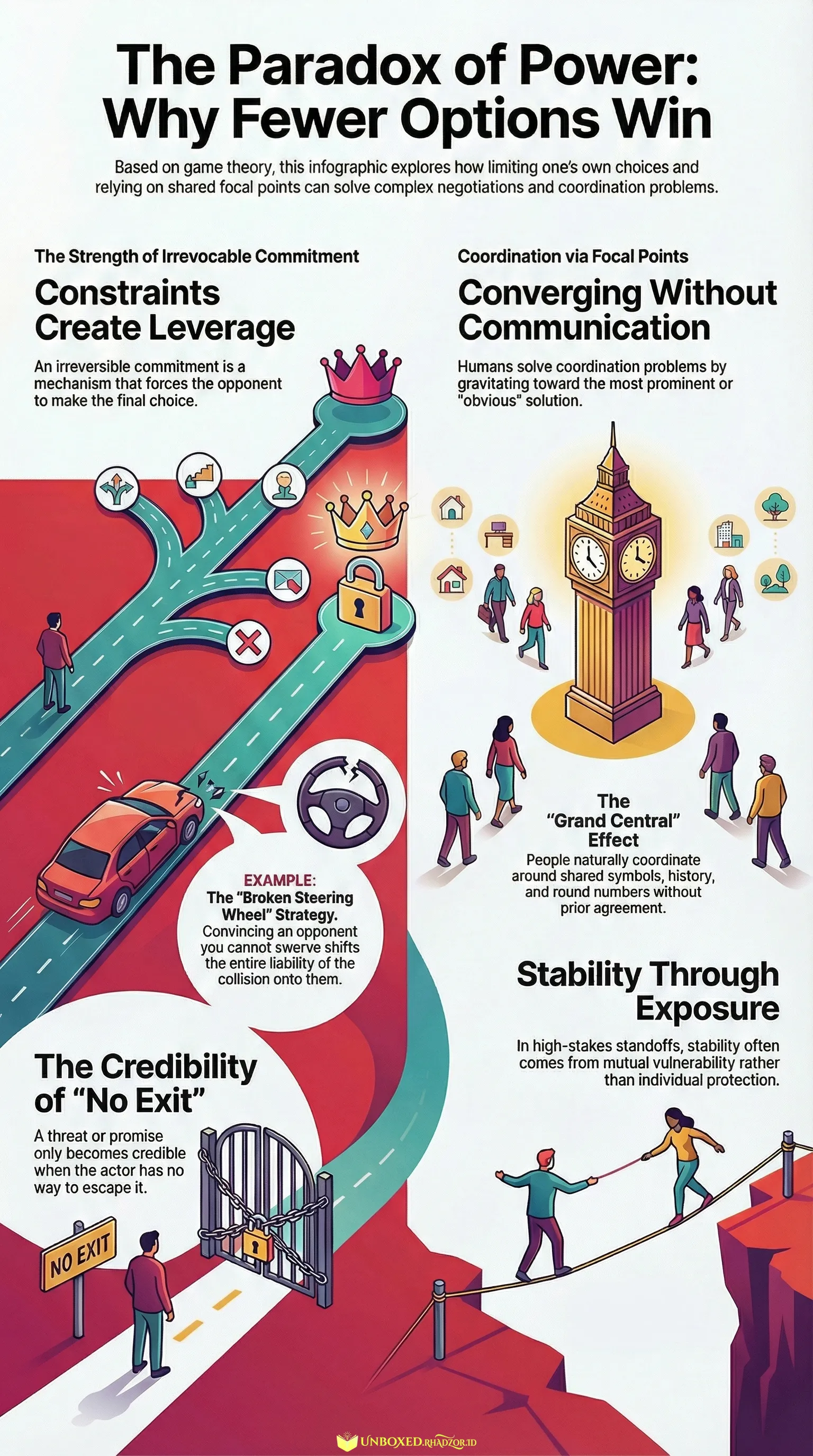
Here's the image that stuck: two cars, narrow road, heading straight at each other. Who swerves? Rational answer — whoever values their life more. But flip that around. If you can convince the other driver that you *cannot* swerve — that your steering wheel is broken, that you're already committed, that there is no version of this where you back down — then suddenly they're the only one with a choice to make. And choices, in a standoff, are liabilities.

Schelling calls it burning the bridges behind you. Not as a metaphor for courage. As a *mechanism*. An irreversible commitment isn't weakness. It's leverage.

> *"...if the buyer can accept an irrevocable commitment, in a way that is unambiguously visible to the seller, he can squeeze the range of indeterminacy down to the point most favorable to him."*

Think about how often this plays out outside of Cold War strategy rooms. The job candidate who genuinely doesn't need the role walks in with more bargaining power than the most qualified person in the room — not because they're better, but because they can't be pressured. The one who shows desperation has already lost before the conversation starts. Flexibility, it turns out, is exactly what makes you easy to push around.

---

I thought I understood nuclear deterrence before reading this. Weapons exist so they won't be used. That's the tidy version.

Schelling dismantles it.

Stability in a nuclear standoff doesn't come from strength. It doesn't come from protecting your population. It comes, counterintuitively, from *leaving your population exposed*. The logic works only if both sides know that a first strike guarantees retaliation — and retaliation is only guaranteed if the weapons that fire back can't be destroyed before they launch.

Which means the doctrine that kept the world from ending wasn't "protect your people." It was closer to: *make sure your people remain killable, so the other side believes you won't strike first.*

Pause on that for a second.

> *"...the 'balance of terror', if it is stable, is simply a massive and modern version of an ancient institution: the exchange of hostages."*

This isn't a metaphor. This is a literal description of military doctrine — one that shaped the last eighty years of geopolitics and, in some form, still does. The wives and children of ancient kings, held across enemy lines to guarantee good behavior. Scaled up to millions of civilians who never signed up for the arrangement.

---

The concept I keep returning to, though, is focal points.

Schelling poses a thought experiment: you need to meet a stranger in New York City today. No communication, no prior arrangement, no agreed location. Where do you go?

Most people say Grand Central Station. Noon.

Nobody coordinated that. There's no logical derivation that lands there. But people *converge* on it because it's prominent, it's obvious, it feels like the answer — and that collective sense of "this is where you'd go" is enough to make it real.

This is how humans solve coordination problems without talking. Not through contracts or explicit agreement, but through shared context — history, symbols, round numbers, precedents. The 50/50 split feels "fair" not because of math, but because it's a focal point. Ceasefires happen along rivers because rivers are visible. Prices feel wrong when they cross a threshold nobody formally set.

Once you start noticing focal points, they're everywhere. In unwritten office norms. In how protests self-organize. In why certain social behaviors stabilize without anyone enforcing them.

---

What unsettles me most about this book isn't the subject matter. Nuclear war, Cold War brinkmanship — that's all heavy, but it's also distant.

What unsettles me is how *ordinary* the underlying logic is.

Schelling isn't writing about monsters or madmen. He's writing about rational actors who arrive at terrifying conclusions not because they're evil, but because the structure of the situation pulls them there. The game has its own gravity. And once you're in it, the "rational" move is often the one that looks, from the outside, completely insane.

A threat is only credible if you'd actually follow through. A promise only binds if you can't escape it. And the most effective way to win a standoff is sometimes to make absolutely sure you have no exit.

> *"A threat is only 'too large' if its very size interferes with its credibility."*

We play smaller versions of these games constantly — in negotiations, in arguments, in the slow-burning dynamics of relationships and organizations. The logic doesn't stop at the level of superpowers. It just gets quieter.

---

I didn't finish this book feeling smarter. I finished it feeling like someone had peeled back a layer of how things actually work and then, very calmly, put the cover back on.

The layer is still there. I just know it now.

That's not exactly comforting. But it's probably more useful than not knowing.