Here's something that stayed with me long after I closed this book.

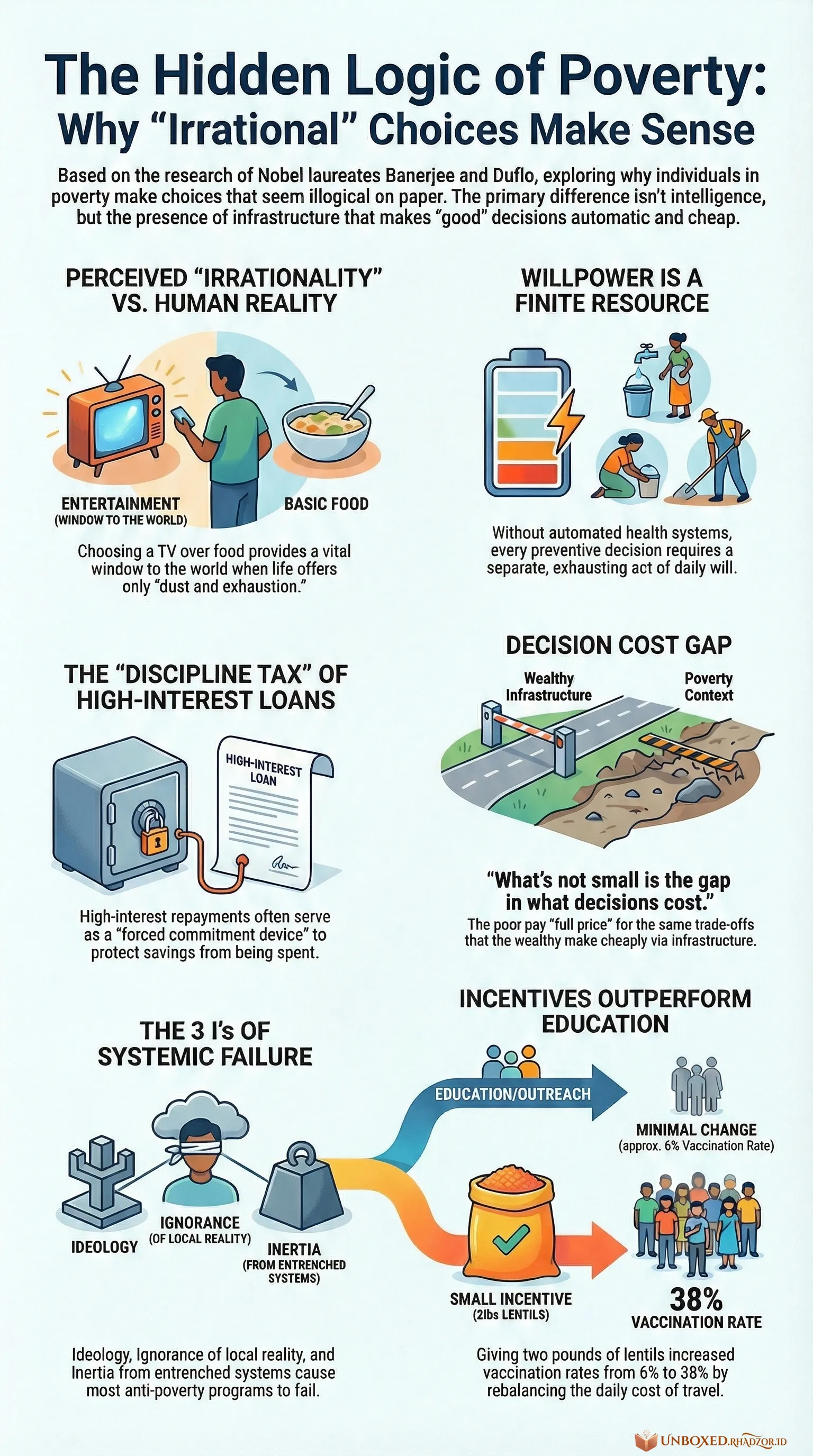
A man named Oucha Mbarbk in Morocco spent months saving up. When he finally had enough, he bought a television, a DVD player, and a satellite dish. His family complained they didn't have enough to eat. When asked why, he laughed: *"Ach, Fernsehen ist wichtiger als Essen!"* — Television is more important than food.

The instinct is to shake your head. But sit with it for a second.

Imagine living somewhere with no cinema, no café, nothing to do after dark except stare at the same walls you've stared at your whole life. Every day is hard labor with no guarantee of tomorrow. The only window to something else — to stories, to laughter, to a world that isn't dust and exhaustion — is that screen in the corner. Suddenly Oucha's choice doesn't sound irrational. It sounds deeply human.

That's what makes *Poor Economics* the kind of book that gets under your skin. Not because it documents how terrible poverty is — you already knew that. But because it quietly forces you to admit that somewhere along the way, you'd started thinking of poor people as a different category of human. The kind that should only care about calories and survival, not pleasure, not dignity, not the feeling that life is worth living today and not just someday.

---

Banerjee and Duflo — two Nobel-winning economists — weren't interested in the big ideological fights. They went to the field, measured small things, and kept finding results that felt almost deliberately counterintuitive.

Take health. Simple logic says: if someone can barely afford medicine, they'd be obsessive about cheap prevention — mosquito nets, water purification tablets, vaccines. They're not. Demand for cheap preventive care is surprisingly low. But those same people will go into debt with a moneylender to pay for a reactive treatment — an antibiotic injection, a steroid shot from a clinic whose qualifications nobody checked — when they're already sick and desperate.

This isn't stupidity. It's the same cognitive wiring we all run on: humans everywhere respond more urgently to a crisis that's already happening than to a risk that might happen later. The difference is that some people have systems that quietly make the preventive decisions for them — mandatory vaccinations to enroll in school, workplace health coverage that kicks in automatically. They don't have to *remember* to stay healthy. The infrastructure remembers for them.

Without that infrastructure, every health decision requires a separate act of will. Every single day. With the same finite mental energy that runs out in all of us by afternoon.

---

The paradox I kept turning over was almost mechanical in its simplicity: poor people borrow money at high interest rates and deposit it straight into savings accounts.

On paper, financially absurd. In practice, completely logical. The weekly repayment schedule functions as a forced commitment device. Without it, the money dissolves — not through theft or disaster, but through the completely ordinary human tendency to spend what's available. Anyone who's ever set up an automatic deduction before their paycheck hits their main account — not because they're bad with money, but because they're honest about how money works on them — understands the mechanism exactly. The difference is not everyone has to pay interest for the privilege of that discipline.

---

One small finding broke something open for me. In rural India, childhood vaccination rates sat at 6%. Researchers tried education campaigns, outreach programs, reducing distance to clinics. Rates barely moved. Then they tried one thing: giving every family that showed up at a vaccination camp two pounds of lentils. Rates jumped to 38%.

Two pounds of lentils. Not a lecture. Not an awareness campaign.

This isn't about poor people being buyable. It's about the fact that decisions don't happen in a vacuum — they get weighed against real costs on that specific day: lost wages, transportation, skipped meals, time pulled away from something urgent. The lentils didn't bribe anyone. They rebalanced the equation until it made sense to show up.

---

But there's one part of the book where I had to stop and just sit with it.

The authors describe what's been called the phenomenon of "missing women" — a demographic gap across parts of Asia where women are statistically underpresent compared to what biology would predict. Much of it traces back to a brutal logic: in systems with no social safety net, no state pension, no reliable financial infrastructure, children — specifically sons — become the only retirement plan available. Daughters are seen as a liability: they leave the family, they require a dowry, they can't be counted on in old age. So the calculus, in its most extreme forms, produces neglect, abandonment, and selective abortion.

What makes it harder to look away from is that it isn't irrational within its own context. It follows a logic that is horrifying precisely because it is consistent.

Poverty doesn't just limit options. It warps what people come to believe is right.

---

I didn't finish this book feeling more hopeful or more defeated about the world. I finished it feeling more honest — specifically about something the authors call the *3 I's* that quietly kill most anti-poverty programs: rigid Ideology that ignores what's actually happening on the ground, Ignorance of local reality, and Inertia from systems too entrenched to change even when the evidence says they should.

None of those are dramatic villains. They're just the ordinary machinery of how institutions fail people slowly, without anyone being obviously responsible.

And maybe more uncomfortably: we all operate on some version of the same logic as Oucha. We all spend money on things that make today feel more livable at the expense of something more sensible later. We all resist the abstract future in favor of the concrete present. The question isn't really who is rational and who isn't.

The question is who gets to make that trade-off cheaply, and who pays full price for it.

---

*The gap between good decisions and bad ones is smaller than we like to think. What's not small is the gap in what those decisions cost.*