I'll start with the part that broke my brain a little.

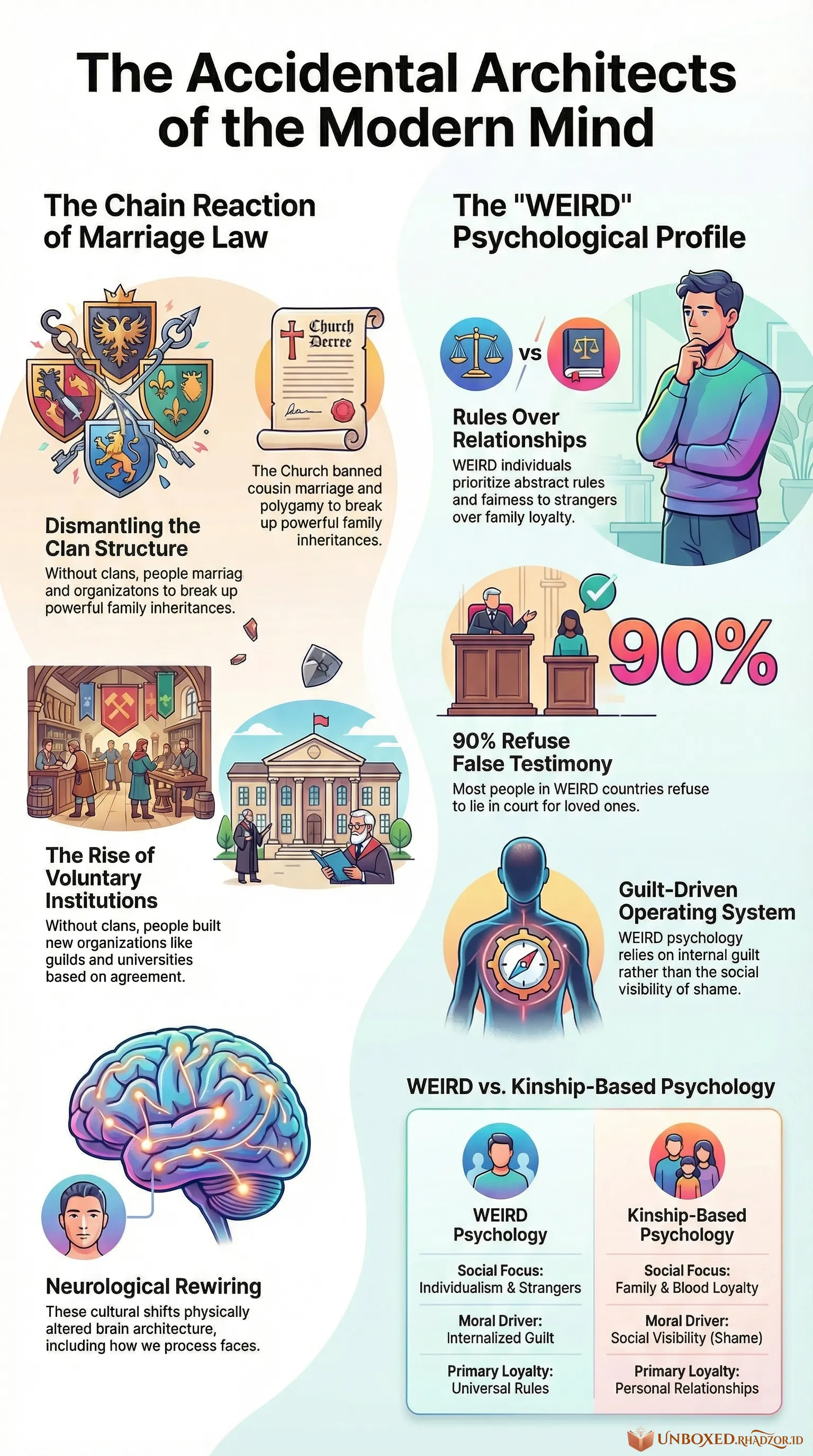
The psychological profile we call "Western" — the individualism, the trust in strangers, the almost pathological commitment to abstract rules over personal loyalty — didn't come from Greek philosophy. It wasn't the Enlightenment. It wasn't some natural endpoint of civilizational progress. It came from a medieval Catholic Church policy about who you're allowed to marry.

The Church banned cousin marriage. Then marriage to more distant relatives. Then polygamy. Over centuries, this quietly dismantled the clan structures that had held virtually every human society together since forever. When the clan disappears, people need new ways to organize. So they built guilds, charter towns, universities — institutions built not on blood, but on agreement. On rules. On trusting people you've never met.

That's where WEIRD psychology comes from. Not from genius. From a bureaucratic decision about marriage law.

---

WEIRD — Western, Educated, Industrialized, Rich, Democratic — isn't just a demographic label. Joseph Henrich uses it to describe a genuinely strange psychological profile when you zoom out to the full picture of human history and global variation. WEIRD people are highly individualistic, analytically minded, and — here's the twist — they extend more trust and fairness to strangers than to their own families.

Think of it this way: clan-based societies are like a tight family group chat. You protect your own, you lie for your own, you build everything around the people you share blood with. WEIRD societies are more like LinkedIn. You can collaborate with complete strangers as long as the rules are clear — but you won't commit perjury to save your best friend.

Over 90% of people in WEIRD countries say they would refuse to give false testimony in court, even for someone they love. In a kinship-intensive culture, that's not integrity. That's betrayal.

---

Pause here for a second.

Because this isn't really about which system is better. It's about how deep culture actually runs — well below the level of conscious values, below the things we think we've "chosen" to believe. Henrich makes the case that culture doesn't just influence psychology. It physically rewires it. Men in monogamous marriages show measurable drops in testosterone. Learning to read literally restructures your brain's neural architecture — and as a side effect, slightly reduces your ability to recognize faces.

Not metaphorically. Neurologically.

The environment shapes the organism. We've always known this about bodies. Henrich is saying it's true for minds too, and the timescale is centuries, not lifetimes.

---

The paradox I can't stop turning over: the medieval Church's marriage policies weren't designed to produce liberalism. They were designed to extend institutional control — to break up large family inheritances and redirect wealth and loyalty toward the Church. That was the point. And yet the unintended downstream effect, across five or six centuries, was the dissolution of clan loyalty, the rise of impersonal markets, the emergence of analytic thinking, and eventually — the Scientific Revolution, the Enlightenment, and secular governance systems that would go on to actively fight the Church that accidentally created them.

The Church dug its own grave. Over 600 years. Without noticing.

If you're used to history as a story of intentions producing outcomes, this book will make you uncomfortable. The most consequential shifts in human civilization often arrive as side effects — collateral damage from decisions aimed at something else entirely.

---

The part that unsettled me most, though, is closer to home. For decades, the majority of psychology research was conducted on a single population: undergraduate students at Western universities. The findings were published as discoveries about human nature. Universal truths about how the mind works.

They weren't. They were findings about the psychologically most unusual population on the planet — the tail end of the distribution, mistaken for the center.

This isn't just an academic footnote. It shaped policy, social interventions, institutional design — the whole architecture of how modern societies try to understand and manage human behavior. Built on an assumption that turned out to be wrong in the most fundamental way.

---

There's also something quietly destabilizing about what Henrich says about guilt versus shame. WEIRD people are guilt-driven — they feel bad when they violate their own internal standards, even when no one's watching. Most of the world runs on shame — the social visibility of failure matters more than the private experience of it. Neither is more evolved. They're just different operating systems, shaped by different histories.

And yet the guilt-driven model has spent the last century assuming it's the default. Building courts, HR departments, and therapy culture around the assumption that the inner life is the real one.

---

I closed the book without a clean conclusion, and I think that's appropriate. What stays is not a lesson, exactly. It's more like a quiet vertigo — the realization that the way you think, the way you feel guilty, the way you trust a stranger or refuse to lie for a friend, none of that is the output of pure reason. It's the output of a very long, very contingent chain of historical accidents.

Somewhere in medieval Europe, a Church official was drafting a policy on cousin marriage. He had no idea he was writing the source code for how a billion people would eventually think.

That's either profound or absurd. Possibly both.