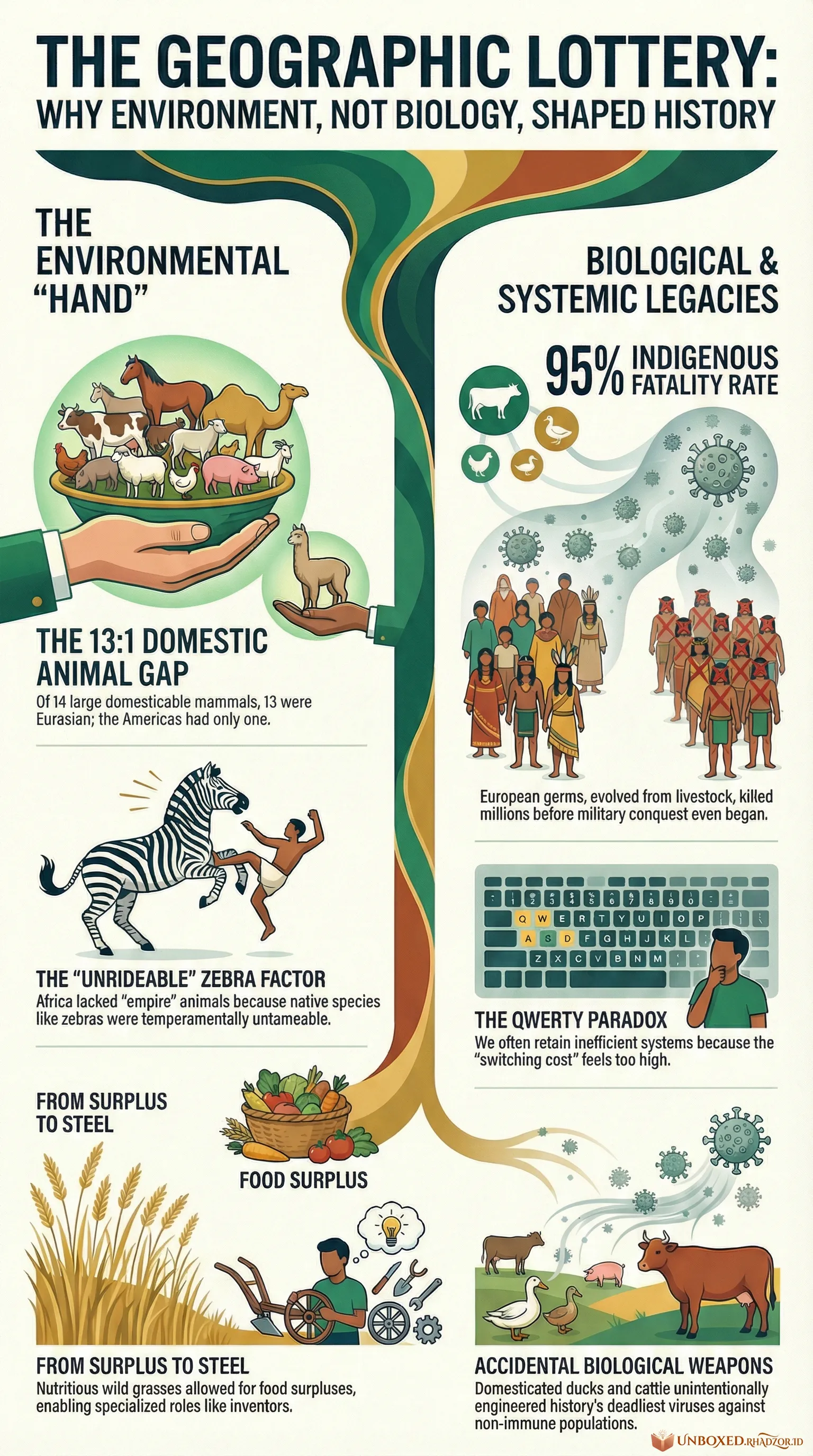
I've been thinking about zebras.

Not in a poetic way. In a genuinely irritating, can't-let-it-go way. Because apparently, the reason Africa never built an empire on horseback isn't some deep cultural failure — it's because zebras are, by nature, absolutely unrideable. They panic easily, they bite without letting go, and they can dodge a lasso with an agility that would embarrass most cowboys. The continent had large animals. Just not the right ones.

That one detail cracked something open for me while reading Jared Diamond's *Guns, Germs, and Steel* — a book that spent 400+ pages answering a question asked by a man named Yali, a local politician from Papua New Guinea, on a beach:

*"Why is it that you white people developed so much cargo and brought it to New Guinea, but we black people had little cargo of our own?"*

Most people, if they're honest, carry a quiet default answer to that question somewhere in the back of their heads. Something about civilization, work ethic, intellectual tradition. Diamond's answer is far less flattering to everyone — and far more uncomfortable to sit with.

---

The answer is geography. Specifically: dumb luck geography.

Eurasia won the lottery — not because its people were more driven or more inventive, but because the Fertile Crescent happened to contain the world's most nutritious wild plants and the most domesticable wild animals. Of the 14 large mammals successfully tamed by humans before the 20th century, 13 were Eurasian. The Americas had one (the llama). Australia had none.

Think of it like two players dealt cards from the same deck, with identical skill. One gets a strong hand, one gets trash. The winner isn't the smarter player. The winner is the one who got better cards.

From domesticated animals and plants came food surplus. From surplus came people who didn't need to farm — bureaucrats, soldiers, inventors, priests. From there: writing, steel weapons, centralized power. And from those same domesticated animals came something that would prove deadlier than any sword: germs.

---

This is the part that genuinely unsettled me.

When the Spanish arrived in the Americas, they didn't conquer a continent through military genius. They did it largely through smallpox, measles, and influenza — diseases that had evolved from viruses living in their cattle and pigs. An estimated 95 percent of the indigenous population died, many of them before ever seeing a single European face. The disease traveled faster than the news of the invasion.

So the irony is almost too much: Eurasian civilization built itself on animal domestication, and those same animals quietly engineered the most effective biological weapon in human history — deployed against people who had no immunity, no warning, and no idea that keeping livestock could even produce such a thing.

We domesticated ducks. The ducks gave us flu. The flu killed millions of people on continents that had never seen a duck farm.

---

Here's the paradox I keep returning to, because it lives closer to home.

The QWERTY keyboard you're reading this on — or that I typed this on — was designed in 1873 specifically to *slow typists down*, so that old mechanical typewriters wouldn't jam. The jamming problem was solved long ago. The keyboard layout stayed, because switching costs were deemed too high for the industry.

We inherited a tool designed to limit us, from a problem that no longer exists, built by people trying to protect a business model that has since collapsed. And we just… kept it.

That's not really about keyboards. That's a pattern. How many systems around us are still running on logic that made sense once, in a context that no longer exists — and nobody's changed them because changing feels harder than tolerating them?

---

Diamond writes that history followed different courses for different peoples *"because of differences among peoples' environments, not because of biological differences among peoples themselves."*

That sentence should feel liberating. And in one sense, it is. But sit with it long enough and something else surfaces — the quiet realization that most of the world's inequalities today are still riding rails that were laid thousands of years ago, by factors nobody chose. Which country is wealthy, which is dependent, who has the technology and who buys it — so much of that traces back to what wild grasses happened to grow where, and which animals happened to tolerate human company.

I live in a country that spent centuries being the destination — for spices, for land, for labor. Not because the people here were less capable. Partly because there were no horses to ride into battle, no wheat to stockpile into empire, no epidemic diseases to export back to the people arriving by ship.

And now we're still using QWERTY. Still operating inside systems we didn't design, for problems we didn't create, toward outcomes that were largely scripted before any of us were born.

---

Yali's question never really got answered. It just got a forwarding address.