Here's the thing about _Thinking, Fast and Slow_ that I can't stop turning over: judges grant parole more often right after lunch. Not after reviewing new evidence. Not after consulting with colleagues. After _eating_.

Someone's freedom, in the most literal sense, is partially determined by whether the person holding the gavel is hungry or not.

Kahneman doesn't tell this story to humiliate judges. He tells it because judges are all of us — we just don't sit behind a bench, so we never notice how depleted we are when we make the calls that actually matter.

---

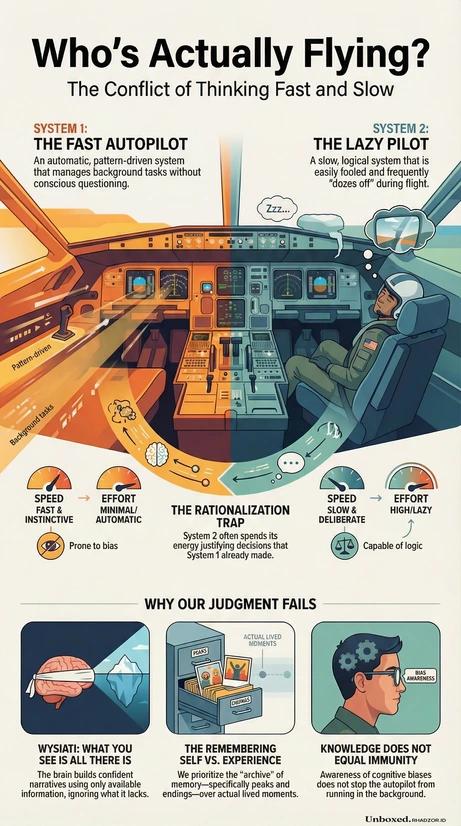
The book's core idea sounds simple enough: the human mind runs on two systems. One fast, automatic, pattern-driven, emotionally loaded. The other slow, deliberate, logical — but lazy, easily fooled, and frankly, often asleep on the job. The concept itself isn't new anymore. What gets under your skin is what it actually implies if you take it seriously.

Think of an airplane's autopilot. It can keep the plane level, handle mild turbulence, even land under certain conditions — all without the pilot touching anything. System 1 works exactly like that. Efficient, indispensable, always running in the background. The problem: autopilot has no mechanism to question itself. It cannot ask, _"wait — am I reading this situation correctly?"_ That requires an actual pilot. And that pilot — System 2 — has a habit of dozing off mid-flight.

---

The bias catalog in this book has basically become LinkedIn content at this point. Anchoring, availability heuristic, loss aversion — people drop these terms in meetings now like they're seasoning. What actually unsettled me was something quieter: **WYSIATI**. _What You See Is All There Is._

The brain doesn't wait for complete information before drawing conclusions. It weaves a coherent narrative out of whatever's available, then feels _confident_ about that narrative. And here's the genuinely strange part — the less information you have, the easier it is to feel certain, because there's no contradictory data disrupting the story.

This explains so much about the current information environment. The people shouting loudest in comment sections are often the ones who read the headline and stopped there. We've all been that person — fifteen minutes into a topic, absolutely convinced we understand the situation. We don't feel our ignorance. We feel the _story_ we've already built.

Kahneman puts it plainly: _"We can be blind to the obvious, and we are also blind to our blindness."_ That's not a poetic observation. That's a structural description of how the machine operates.

---

There's a paradox in the book that I found equal parts funny and quietly unsettling: we don't actually live for experience. We live for memory.

The _experiencing self_ — the one feeling things in real time — barely gets a vote. Major decisions are made by the _remembering self_, the one that curates, edits, and stores. Which means we're not optimizing for moments. We're optimizing for the archive.

The tourist frantically photographing every corner of a city isn't necessarily enjoying it more than the person who left their phone in the bag. They're doing labor — for a future version of themselves who will scroll through photos and feel like they _were there_. Except memory doesn't store everything. It stores the peak and the ending. Everything in between gets quietly compressed or dropped entirely.

Pause on that for a second. We make real sacrifices — time, money, energy — to create experiences that our own memory system will immediately distort and partially delete.

---

I didn't come out of this book making better decisions. Kahneman is honest about that — knowing your biases doesn't neutralize them. You might catch yourself occasionally, but the autopilot is always running, always faster, always more confident than it has any right to be.

What stayed with me is something more uncomfortable than a lesson. It's closer to a standing question: if System 1 is running most of the show, and System 2 is mostly rationalizing after the fact, and even a fully engaged System 2 can still be systematically wrong —

Who's actually flying this thing?

Maybe there's no clean answer. Maybe the mild discomfort of sitting with that question is itself the closest thing to thinking slowly that most of us will manage on any given day.

That's not nothing, I suppose. But it's also not exactly reassuring.