Full disclosure before we start: I almost didn't read this book because the title felt a little too confident. *Why Nations Fail.* As if two professors could wrap up a question that's kept thousands of economists up at night — in a single volume. Bit presumptuous, I thought.

Turns out I was wrong. And I'm perfectly fine admitting that.

Daron Acemoglu and James A. Robinson don't answer the question the way I expected. They don't show up with a magic formula or a tidy policy prescription. They show up with something far more uncomfortable: a mirror.

---

**First: Not Fate, Not Climate, Not Culture — It's About the Rules of the Game**

We've all heard the classic arguments. "Tropical countries are lazy because the heat makes people drowsy." Or the more sophisticated version: "It's just their culture — hard to change." I won't judge anyone for thinking this way. Honestly, I used to think it too.

But let's try a simpler lens.

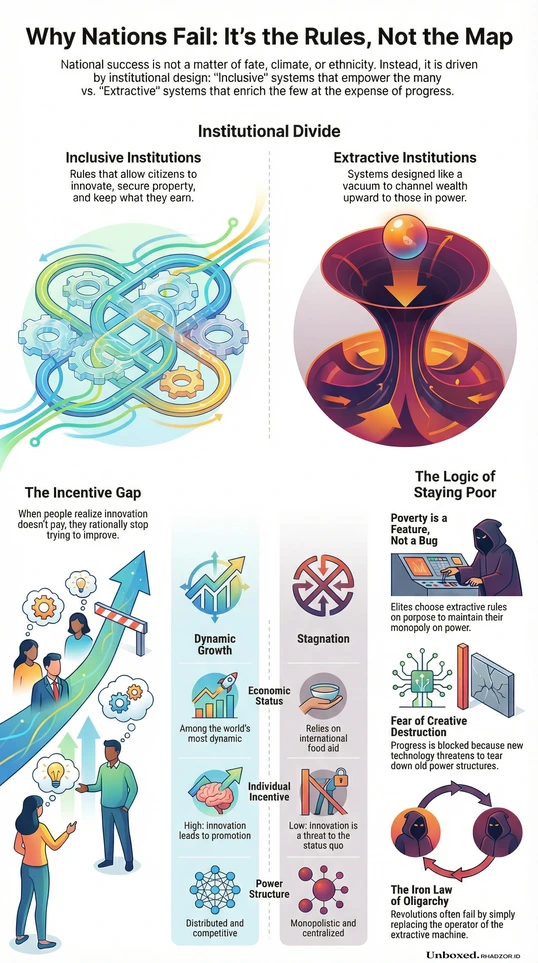
North Korea and South Korea share the same peninsula, the same climate, the same ethnicity — and up until around 1945, they were literally one nation with the same culture. Today, one side is among the most dynamic economies on the planet. The other relies on international food aid to keep its population alive.

Same climate. Same culture at the start. So what's different?

The rules.

Acemoglu and Robinson distill this into two deceptively simple concepts: *inclusive* institutions and *extractive* institutions. The first creates an ecosystem where anyone can work hard, innovate, own property securely, and actually keep what they earn. The second operates like a giant vacuum — channeling everything produced by society upward, into the hands of whoever controls the rules.

Here's an analogy that might hit closer to home. Picture two offices at different companies. In the first, anyone with a good idea can pitch it, gets credit for their work, and moves up based on real contribution. In the second, every good idea gets claimed by the boss, anyone who shines too bright becomes a threat, and promotions depend on personal loyalty rather than actual capability.

The employees in the second office aren't less intelligent or less ambitious. They've simply learned — rationally — that innovation doesn't pay. So they stop trying.

Now scale that dynamic to an entire nation. That's the argument.

---

**Second: The Elite Aren't Ignorant — And That's Precisely the Problem**

This is where the book started keeping me up at night.

Our common assumption is that leaders who allow their countries to stay poor must be doing so out of ignorance or incompetence. If only they *knew* the right approach, surely they'd take it. The implied solution, then, is education, expert consultation, foreign technical assistance.

Acemoglu and Robinson dismantle this assumption with clinical precision.

There's one line in this book I read three times before it fully landed:

> *"Poor countries are poor because those who have power make choices that create poverty. They get it wrong not by mistake or ignorance but on purpose."*

They know exactly what they're doing. And that choice is entirely rational — from where they're standing.

Economic progress requires innovation, and innovation is inherently destructive of existing order. Schumpeter called it *creative destruction* — every wave of advancement tears down old structures to make room for new ones. For those of us at the bottom, that sounds like good news. For those already comfortable at the top of the old structure, it's an existential threat.

So it's not irrationality that leads elites to block progress. It's the opposite: a very deliberate, very self-serving calculation. Allowing inclusive economic growth means allowing a new class to emerge — one that will eventually demand a political voice. And that threatens their monopoly on power.

Looked at this way, mass poverty isn't a system failing. It's a system working exactly as designed.

---

**The Plot Twist: Revolution Often Just Changes the Players, Not the Game**

Here's where the book serves up its most bitter irony.

If the problem is elites running an extractive machine for their own benefit, the solution seems obvious: overthrow them, replace them with pro-people leadership, done. It's a narrative we've heard hundreds of times — from the French Revolution to the post-colonial independence movements across Africa and Asia.

But what actually happened next? More often than not, only the faces on the posters changed. The machine stayed exactly the same. Yesterday's revolutionaries, who marched and shouted in the streets in the name of justice, sat down in the seat of power and discovered that the extractive apparatus was... surprisingly comfortable to operate.

Sociology has a name for this pattern: the *iron law of oligarchy*. In nearly every organization and power structure, there's a natural gravitational pull toward concentration of control in the hands of a few. Not because humans are inherently corrupt, but because the incentives and dynamics of power operate with remarkable consistency across time and geography.

This isn't pessimism. It's an empirical observation drawn from several hundred years of recorded human history.

---

**A Grounded Closing**

I finished this book feeling two things simultaneously: clarity and a quiet kind of exhaustion.

Clarity, because I now have a more honest framework for understanding why the gap between nations isn't about karma, geography, or cultural laziness. It all traces back to institutional design — who writes the rules, and whose interests those rules actually serve.

Exhaustion, because building genuinely inclusive institutions turns out not to be a single-generation project. It requires time, the kind of unglamorous consistency that rarely makes headlines, and — perhaps most difficult — a collective capacity to resist handing everything over to one charismatic savior figure.

As long as we keep waiting for a messiah — whether that's an inspirational politician, a foreign investor promising prosperity, or any leader framed as the answer to everything — we're essentially standing in line to be fed into the same machine, just with a different operator.

Good institutions are slow, bureaucratic, and deeply unsexy. But they're the only thing history has shown to actually work in the long run.

Everything else is just a compelling story that ends badly.