Let me be upfront about something.

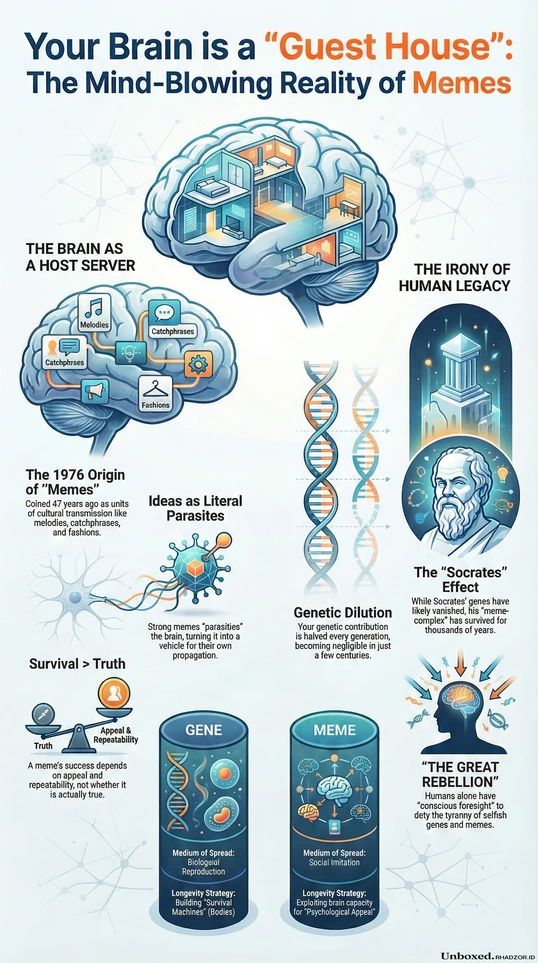
When I first encountered the word "meme" in this book, my brain immediately went to cats wearing hats or that one guy with the bewildered expression. Turns out I was off by about 47 years — Richard Dawkins coined the term in 1976, long before the internet existed, long before we all became apes scrolling TikTok horizontally in bed.

And after sitting with the actual concept for a while, I completely forgot about the funny images. What replaced them was a question that's been mildly uncomfortable ever since: *what if we're not really the owners of our own thoughts?*

---

### First: Your Brain Isn't a Home. It's a Co-Working Space.

Dawkins defines memes as units of cultural replication — ideas, melodies, trends, ways of thinking — that spread from one mind to another through imitation. Exactly how genes propagate through biological reproduction.

But here's the part that made me sit up straight. Dawkins' colleague N. K. Humphrey argued that a successful meme technically **parasitizes** your brain. Not metaphorically. It converts your mind into a replication vehicle for its own survival — the same way a virus hijacks a host cell's genetic machinery.

Think of your brain as a server. You assume you're the administrator, deciding what runs on your system. But as it turns out, a whole lot of programs have already auto-installed without asking — values embedded in childhood, a song looping in your head at 2 AM, beliefs you're convinced are products of your own independent reasoning.

Who installed them? Memes. When? Throughout your entire life. By what method? Social imitation you never noticed you were performing.

---

### Second: Natural Selection Is Just as Brutal in the World of Ideas

This is where I found Dawkins genuinely compelling.

Memes don't automatically survive. They **compete**. And the battlefield is the finite amount of time and memory space inside the human brain. To win, an idea needs three things: the ability to spread fast, the capacity to be transmitted without losing its core shape, and longevity.

Look around. Why does a specific ad jingle still occupy real estate in your head even though you never intended to memorize it? Because it won evolutionarily — high fecundity, easy to replicate, hard to dislodge. It beat out hundreds of other memes that tried to enter your attention that same day.

And here's the plot twist that actually matters. We pride ourselves on being critical thinkers, resistant to influence. But a meme's survival criteria has nothing to do with whether the idea is *true* or *good*. It only needs to be sticky, repeatable, and hard to forget. Truth is a bonus, not a prerequisite.

Dawkins uses religious belief as an example of an extraordinarily successful meme-complex — not to declare it right or wrong, but to observe its mechanics: psychological reward built in, community reinforcement, and a built-in immune response against competing memes.

This isn't an attack on religion. It's just an observation about how ideas stay alive. Simple as that.

---

### The Biggest Irony: We're Wired to Neglect the One Thing That Could Last

This is the part I liked most, and found most unsettling.

Biologically, we're "programmed" to pass on our genes. But that genetic contribution gets diluted with every generation — half to your children, a quarter to your grandchildren, until it's essentially dissolved into the broader gene pool, statistically invisible.

Dawkins writes that Socrates might still have one or two genes circulating in the world today. *But who cares?* What's actually immortal is his ideas — the meme-complexes of Socrates, Leonardo, Copernicus — still running, centuries after their chromosomes turned to dust.

The irony? We spend enormous energy on things that will fade genetically, while what could genuinely outlast us — ideas, work, ways of thinking — gets treated as secondary. *"I'll get to that eventually."*

---

### Closing: A Rebellion That Isn't Particularly Romantic

Dawkins ends on a note I found refreshingly honest: humans are the only creatures on earth with conscious foresight — the capacity to deliberately push back against the tyranny of both genes and memes.

But I want to add a pragmatic footnote here.

That rebellion doesn't come automatically. Simply being aware that you're being "parasitized" isn't enough. Because the uncomfortable irony is that this very awareness — including the concept you're reading right now — is itself a meme looking for a new host.

The more honest question probably isn't *"am I thinking freely?"* but rather *"which memes am I consciously choosing to let live in my head — and why?"*

If you've never asked yourself that, there's a reasonable chance the answer is being supplied by something that moved in before you had a chance to check the lease.

---

*— written over tea, feeling moderately suspicious of my own thought process*

**[Unboxed]** *Not a review. Not a summary. Just notes from someone who thinks too much after reading.*