**When a Barren Hilltop Defeated Every Logic I Learned**

**Full disclosure:** I picked up *Jerusalem: The Biography* by Simon Sebag Montefiore not for spiritual reasons, not for comfort, and definitely not because I was going through some kind of existential detour. I picked it up because one question has been quietly bothering me for years — why would a patch of dry, isolated, geographically unremarkable land in the Judean highlands cause human beings to slaughter each other, without pause, for over three thousand years? If it were oil or a major trade route, I'd get it. But this? I genuinely needed to understand what I was missing.

Turns out, I was asking the wrong question entirely.

---

**First: Jerusalem Won Because of Its Code, Not Its Land**

I'm used to understanding why cities matter through practical lenses. Coastlines, rivers, mineral deposits, trade corridors. These things show up on maps and explain themselves. Jerusalem doesn't fit that framework at all. Landlocked, arid, perched on a ridge with no obvious strategic advantage. On paper, it has no business becoming the center of anything.

And yet.

Montefiore shows how ancient Jewish communities did something that, viewed through a long historical lens, looks like one of the most quietly brilliant survival moves in human history. When the physical city was destroyed, they didn't lose the city — they migrated its entire identity into text. Heinrich Heine captured it precisely: the Bible as a *"portable fatherland"*, a Jerusalem you could carry anywhere, in the form of written language.

Think of it this way: the city's geography was just the server. When the server got wiped, the community had already backed up everything that mattered into a format that could run on any machine, in any era, across any civilization. The land became secondary. The operating concept survived.

What followed was a long succession of civilizations doing variations of the same thing — inheriting that existing narrative architecture, rebuilding on top of it, and each claiming their version was the definitive one. Not exactly theft, but not exactly original composition either. More like an unending chain of cover versions, where every artist insists they wrote the song.

The remarkable part isn't theological. It's behavioral. A city that had been physically erased multiple times kept growing in cultural mass precisely because it had been converted from a place into an idea.

---

**Second: There Is No "Original" Anything There**

Montefiore uses the word *palimpsest* to describe Jerusalem — a piece of ancient parchment scraped clean and written over, again and again, where the traces of earlier inscriptions never fully disappear.

A single stone in that city might carry a history that passes through a pagan Roman temple, a Byzantine church, an Umayyad mosque, a Crusader garrison, and back to a mosque again. Nobody built from scratch. Every conqueror arrived with an exclusive claim and proceeded to sit on someone else's foundation — someone who had also arrived with an exclusive claim.

This isn't just architectural history. It's a pattern of cognition. The claims that feel most sacred, most rooted, most *ours* are almost always the most recent layer of a very long, very tangled chain of inheritance. Nobody is fighting over ancestral land in any pure sense. They're fighting over narrative ownership — and the chain of custody on that narrative has been passed, broken, forged, and rewritten so many times that tracing it back to a clean origin is essentially impossible.

Everyone in that city lives inside a hybrid reality while loudly insisting on exclusive rights to it.

---

**The Plot Twist: Destruction Was What Made It Immortal**

Here is where the irony cuts deepest.

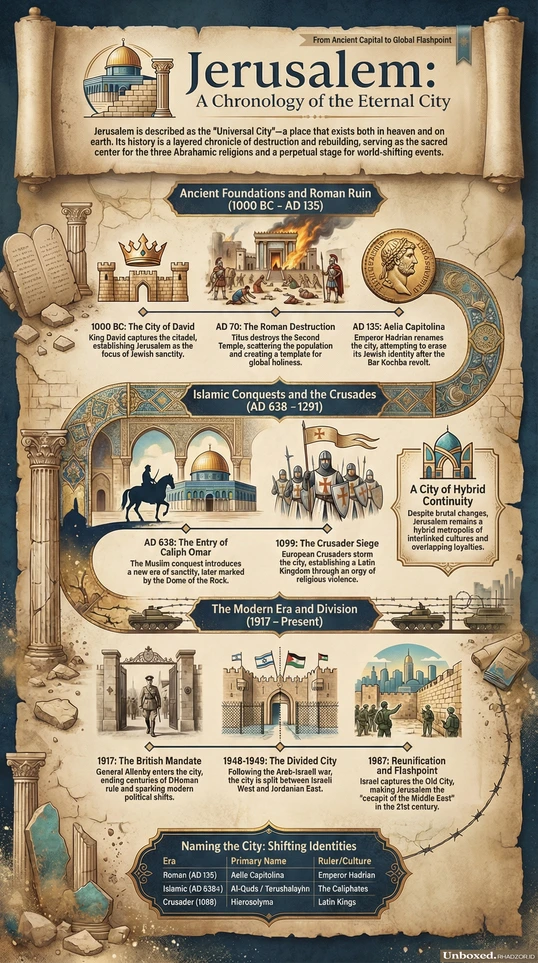
When the Roman general Titus leveled Jerusalem in 70 AD, the strategic logic was straightforward: destroy the center, dissolve the movement. Rational, efficient, precedented.

What actually happened was the opposite.

The destruction of the Temple became a *validation event* for two religions that would go on to shape the next two thousand years of human civilization. For early Christian communities, it was empirical confirmation that prophecy had been fulfilled. For early Islam, six centuries later, the ruins served as visible evidence that divine favor had moved on — making the Temple Mount a theologically logical space for a new revelation to occupy.

Titus, without intending to, had performed the single act most guaranteed to permanently elevate the city's sacred status. He handed it immortality while trying to erase it.

Montefiore frames this as the governing principle of the city's entire history: *the law of unintended consequences*. Nobody who ever tried to settle Jerusalem's meaning managed to do so. Every decisive act — conquest, destruction, reconstruction — produced the opposite of its intended effect.

And no one put it more plainly than Dr. Nazmi al-Jubeh, a Palestinian historian quoted in the book:

> *"In Jerusalem, the truth is often much less important than the myth. Take away the fiction and there's nothing left."*

I read that twice. Then I needed a moment.

---

**Closing Thoughts**

Finishing this book didn't leave me optimistic. It left me more clear-eyed, which is a different thing entirely.

The conflict over Jerusalem isn't really about who has the stronger legal claim, whose history is older, or whose suffering is more legitimate. It runs deeper than any of those arguments. Human beings are, by evolutionary design, narrative creatures. We organize, cooperate, and endure hardship at scale because we share stories that feel larger than ourselves. But those same stories, once they've aged long enough and gathered enough collective weight, become walls that no evidence, no negotiation, and no map can penetrate.

Jerusalem isn't a historical anomaly. It's the clearest mirror we have for how our minds actually work — and why the most dangerous thing a civilization can do is fall completely in love with its own myth.

That's the part nobody really wants to sit with.

---
*— written while overthinking somewhere between the past and the present*