There's a fundamental mistake in how most people approach a book like this.

Most readers pick up *The 48 Laws of Power* by Robert Greene in one of two ways: either with the barely-contained excitement of someone who just found a cheat code to life—as if these 48 laws were some classified manual that had been deliberately kept from them—or with the moral horror of someone convinced they're holding a handbook for villainy, closing it with the firm conclusion that Greene is personally responsible for every toxic workplace they've ever suffered through.

Both are wrong. And that very misreading, ironically, is already covered somewhere inside the book.

So before we get into the substance—and 48 laws is far too many to unpack here, so we'll take the few that leave the most residue in your thinking—one thing needs to be established upfront: this is not a manual for evil. It's a mirror. And like all honest mirrors, the problem isn't the mirror. It's that we rarely like what's looking back at us.

---

**First: power is fundamentally amoral—and we already know this, we just pretend otherwise.**

Most of us were raised on a clean, comfortable narrative: hard work gets rewarded, honesty is the best policy, and goodness wins in the end. That narrative isn't entirely false. But it's dangerously incomplete, and that incompleteness is precisely what blindsides millions of adults the moment they step into the real mechanics of a workplace, a social circle, or any arena where resources, status, or influence are at stake.

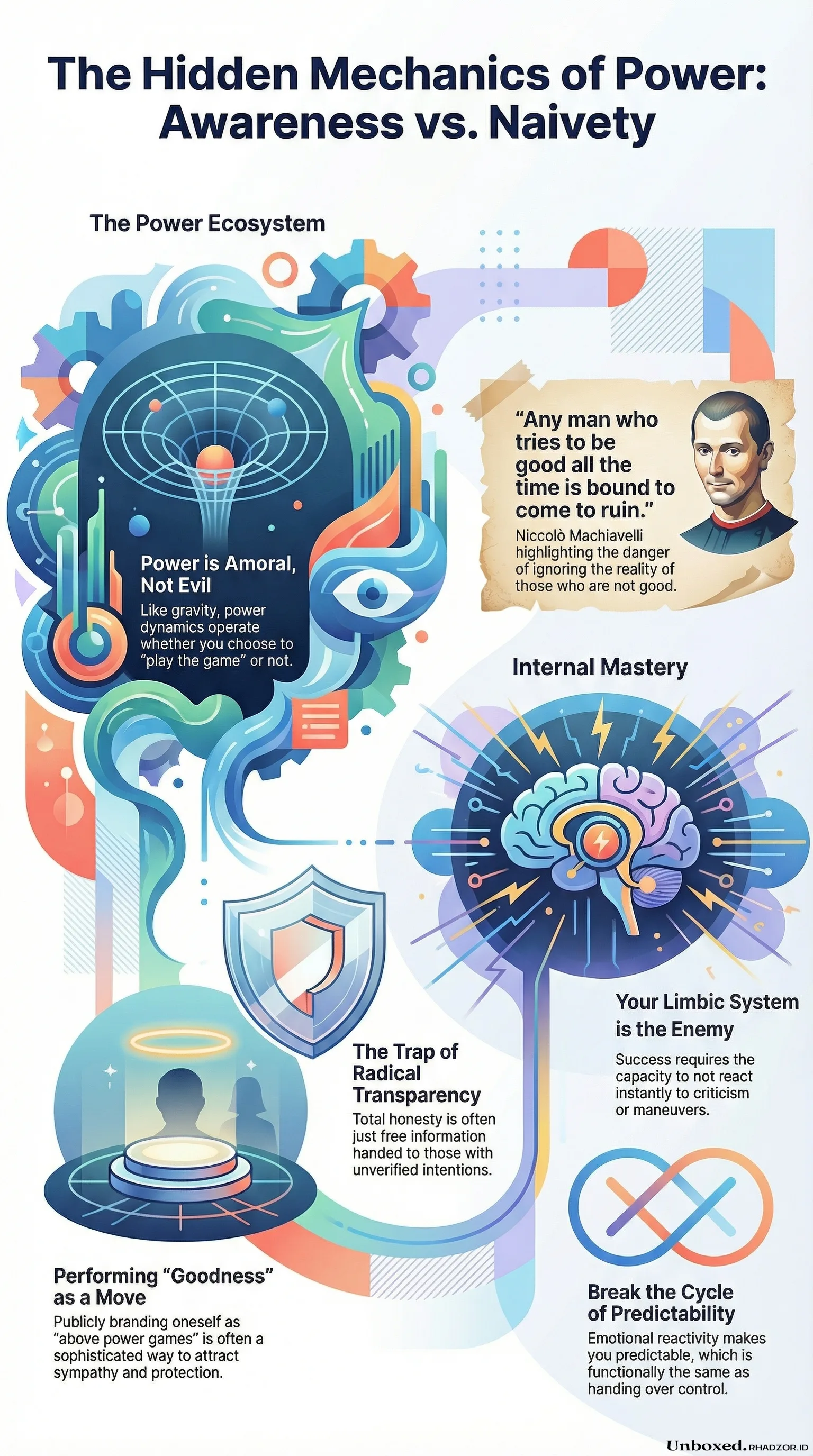
Greene isn't teaching malice. He's pointing out that the dynamics of power operate like gravity—they function whether you believe in them or not, whether you choose to "play the game" or position yourself as the one spectator too principled to participate. Gravity doesn't single out good people for punishment. But it pulls everyone down equally if they don't understand how it works.

Think about an ecosystem—not the romanticized kind with sweeping orchestral music—but the actual thing: a cold, efficient system that has absolutely no interest in your intentions. What survives there isn't the strongest in any absolute sense, but the most adaptive to environmental pressure. Human social dynamics aren't all that different. The environment just looks like a boardroom, a neighborhood group chat, or a committee meeting with people who smile at you with remarkable consistency.

In that environment, radical transparency isn't virtue. It's free information handed to people whose intentions you haven't yet verified.

---

**Second: your biggest adversary isn't your competitor, your boss, or that one colleague who seems to exist solely to undermine you.**

It's your own limbic system—the emotional circuitry that fires before your prefrontal cortex has had a chance to form a complete thought.

Greene returns to emotional mastery repeatedly, not because it makes for a compelling motivational talking point, but because from an evolutionary standpoint, our emotional responses were calibrated for a completely different set of threats. Our ancestors needed an instant fight-or-flight reaction when something with teeth was moving toward them. We, in the present day, more often need the capacity to *not* react instantly when we're criticized in public, passed over for something we deserved, or maneuvered into a corner by someone who's been thinking three moves ahead.

The person who erupts in anger and the person who immediately collapses in appeasement—they both lose. They become *predictable*. And in any dynamic where power is in play, being predictable is functionally the same as handing over control voluntarily.

The people who actually hold leverage—not necessarily the loudest or most visibly dominant—are those who can zoom out. Who can read the room from a higher elevation, identify the pattern, and move at the right moment rather than the emotionally satisfying one.

---

And this is where the book's most interesting irony lives, delivered so quietly that a lot of readers drift right past it.

The people who most loudly reject the idea of power games—who perform the most elaborate displays of honesty, innocence, and refusal to get their hands dirty—are frequently the most sophisticated players in the room. Performing helplessness, cultivating an image of naïveté, or publicly branding yourself as someone "above all this" is itself an exceptionally effective power move. It attracts sympathy, invites protection, and quietly rewrites the rules of engagement without ever appearing to be doing any such thing.

Niccolò Machiavelli, quoted in the book, put it in terms that land like a slow, precise strike:

> *"Any man who tries to be good all the time is bound to come to ruin among the great number who are not good."*

You're welcome to disagree with him. You can find it too cynical, too bleak. But you'll have a hard time arguing there's nothing to it.

---

**To close:**

Understanding this book isn't an invitation to start treating every room like a battlefield and every person as an adversary to be outmaneuvered. That's a shallow reading, and it tends to produce people who are exhausting to be around.

The more useful takeaway is this: the system described here isn't something you enter by choice. You've been inside it for years. What changes after reading something like this isn't the reality—the reality has always been operating this way. What shifts is your level of awareness of the mechanisms already running around you, and quietly, inside you.

Choosing to be good is a legitimate and respectable decision. But confusing naivety with goodness—and then wearing that confusion as a moral badge—that's a different problem entirely.

The rest, as always, is yours to think through.