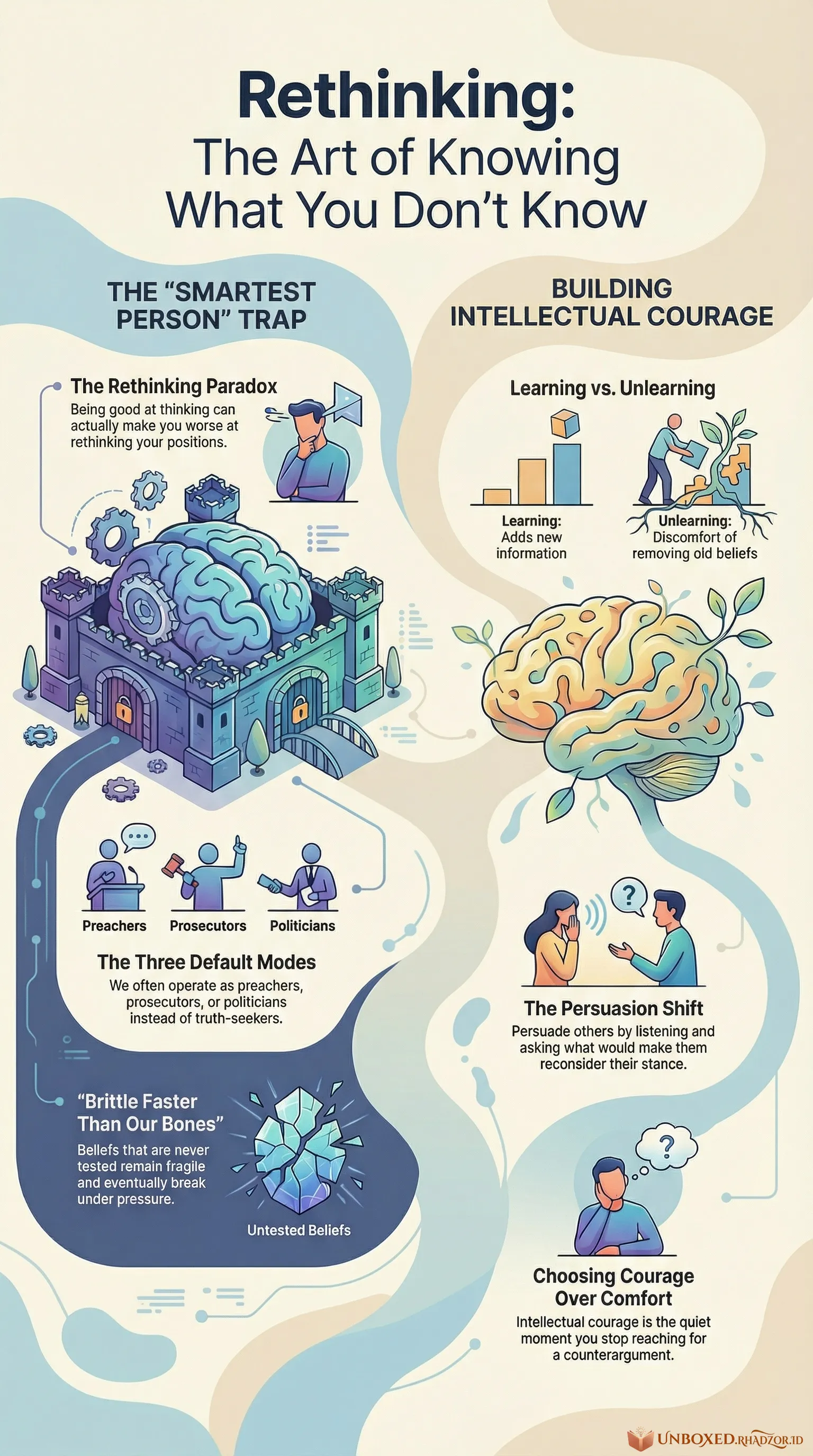
There's a particular kind of blindness that comes with being good at thinking. Not the obvious kind — not ignorance or laziness — but the kind where you've built such a clean, coherent worldview that you stop questioning whether the foundation is still solid.

Adam Grant puts it bluntly: *"being good at thinking can make you worse at rethinking."* I had to sit with that for a moment. Because this isn't about stubborn fools. It's about sharp minds that have gotten so efficient at defending positions that they've quietly forgotten how to abandon them.

---

Grant maps out the thinking modes most of us default to without realizing it — the preacher protecting sacred doctrine, the prosecutor trying to win, the politician chasing approval. None of them are searching for truth. They're searching for confirmation. And the uncomfortable part isn't that some people think this way. It's that *all of us* cycle through these modes, often mid-conversation, often while believing we're being perfectly reasonable.

The analogy that stuck with me: it's like a lawyer who's genuinely convinced they're just "following the evidence" — but has already decided the verdict.

---

What made this book hard to put down wasn't the framework. It was the proof.

A Black musician who convinced members of the Ku Klux Klan to leave the organization — not through confrontation, but through phone calls where he actually listened. A "vaccine whisperer" who changed the minds of hesitant parents not by citing statistics, but by asking: *"What would it take for you to reconsider?"* These aren't feel-good anecdotes. They're case studies in how persuasion actually works — which turns out to be almost the opposite of how most of us attempt it.

We argue like we're right. We rarely listen like we might be wrong.

---

The distinction Grant draws between *learning* and *unlearning-then-relearning* is one I keep coming back to. Learning is additive. It's comfortable. You absorb new information and stack it on top of what you already have — like adding files to a hard drive. Unlearning is different. It means going back to something you've held for years, something that feels like part of your identity, and asking whether it still deserves to be there.

That's not an intellectual exercise. That's genuinely uncomfortable.

Brené Brown wrote about this book: *"Unlearning and relearning requires much more — it requires choosing courage over comfort."* And I think the word "courage" gets underestimated here because we tend to imagine courage as dramatic. But intellectual courage is quieter than that. It's the moment you realize you've been wrong about something — and you don't immediately reach for a counterargument.

---

Pause on this for a second.

How many decisions — organizational strategies, personal beliefs, long-held opinions — are still standing not because they're still valid, but because no one wants to be the person who says: *"Maybe we should rethink this"?* In companies, it's called sunk cost. In relationships, it's called investment. In politics, it's called ideological consistency. But psychologically, it all runs on the same engine: we're more afraid of *appearing* wrong than of *being* wrong.

Grant captures this in a way I haven't been able to shake: our beliefs can become *"brittle faster than our bones."* Which doesn't mean we change our minds easily — it means the opposite. Beliefs that are never tested are like bones that never bear weight. They look intact. Until they're not.

---

*"If knowledge is power, knowing what we don't know is wisdom."*

I'm usually skeptical of lines that sound like they belong on a motivational poster. But this one earns it. Because the problem in an age of unlimited information isn't access to knowledge — it's the quiet, confident assumption that we already have enough of it.

And that assumption, predictably, tends to run deepest in people who read the most.

---

I didn't finish this book with any clean resolutions. No commitment to "be more open-minded" — that's too tidy for what the book is actually saying.

What I'm left with is a single question that's been harder to answer than I expected: *when did I last genuinely change my mind about something that mattered — not because I was forced to, but because I actually chose to reconsider?*

Most of us, if we're being honest, need more than a moment to answer that.