Here's what stayed with me after finishing this book: it's not a self-help book. Or at least, it doesn't stay that way for long if you keep pulling the thread.

James Clear opens with clean math — improve by 1% every day and you'll be 37 times better by year's end. Hard to argue with the arithmetic. But anyone who's ever set a New Year's resolution knows that the gap between *knowing something works* and *actually doing it* is where most of us quietly live. The book's real question isn't "how do habits work?" It's "why don't we do the things we already know we should?"

That's a much darker question. And the answer is weirder than willpower.

---

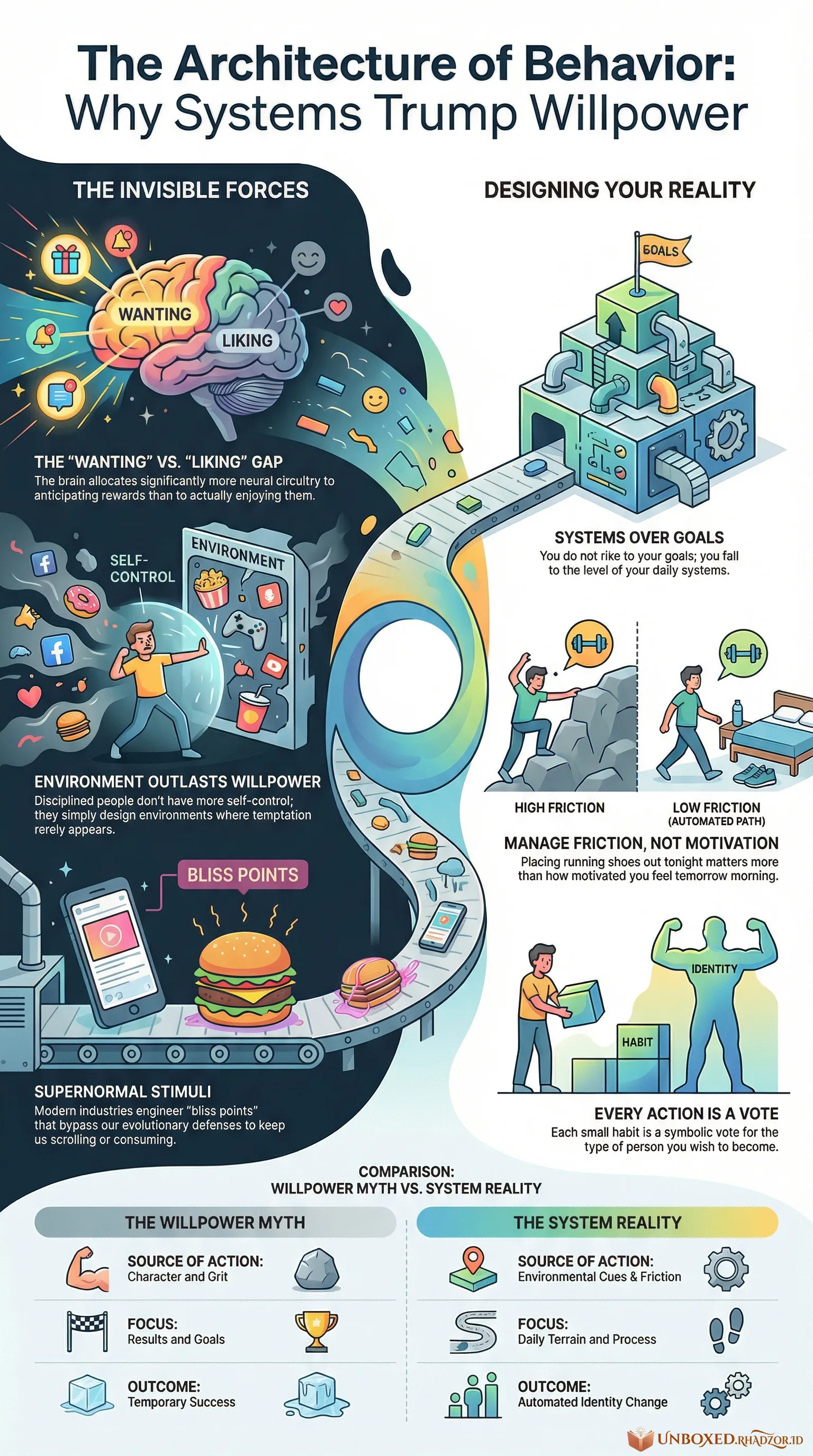
The part that stopped me cold was this: people who appear to have iron self-discipline are not, in fact, exercising more self-control than the rest of us. They're just better at designing environments where temptation rarely shows up in the first place.

Think about what that actually means. The person who "never touches junk food" probably doesn't keep any in their house. The person who reads every night probably has a book on their pillow, not their phone. We've been narrating these as stories about character — about who someone *is* — when they're really just stories about furniture arrangement and friction.

That reframing is either liberating or deeply unsettling, depending on how much of your identity is built around the idea that you're someone who chose to be a certain way.

---

But here's where it gets genuinely uncomfortable.

Clear mentions *supernormal stimuli* — the idea that modern industry has engineered versions of reality so hyper-optimized they completely bypass our evolutionary defenses. The food industry spent decades reverse-engineering the *bliss point*: the precise combination of salt, sugar, and fat that keeps the brain's "I've had enough" signal from ever firing. Social media platforms are built on the same architecture, just applied to attention instead of appetite.

And then there's this: the human brain allocates significantly more neural circuitry to *wanting* rewards than to *enjoying* them. The anticipation is always louder than the satisfaction. Which means we keep scrolling not because the content is good, but because the brain is in hunting mode — and hunting *feels* more alive than finding.

Sit with that for a second. Every time you've opened an app, found nothing interesting, and kept scrolling anyway — that wasn't weakness. That was the system performing exactly as designed. By people whose job it was to make sure you never quite feel done.

---

*"You do not rise to the level of your goals. You fall to the level of your systems."*

I used to read lines like this as motivational shorthand. Now it reads more like a structural diagnosis. Goals are just intentions wearing ambition's clothes. Systems are the actual terrain you walk every day — and most of us inherited our terrain without ever choosing it.

Which brings up the question the book gestures toward but doesn't fully answer: if most of our behavior is the output of environmental cues and industrially engineered cravings, how much of what we call *choice* is actually choice? Clear frames every action as a vote for the kind of person you want to become. That's a compelling metaphor. But in an election where half the ballots are being filled out by your neurochemistry and the other half by a product team in Silicon Valley — what exactly are you voting for?

---

There's also a quieter irony buried in the book that I keep coming back to. The downside of mastering a habit is that you stop paying attention to it. The brain, efficient as it is, essentially files away anything it considers "learned" and stops monitoring for errors. But real mastery — the kind that separates good from exceptional — lives precisely in those small details that only reveal themselves when you're still watching closely.

In other words: the better you get at something, the more deliberately you have to resist the automation that made you good at it. You have to keep treating yourself like a beginner even when you're not.

That's not a comforting thought. It's just an accurate one.

---

I didn't finish this book with a new morning routine or a habit tracker. I finished it with a quieter, more inconvenient question — one I'm still not done with: *How much of what I do every day is actually me, and how much of it is just a response to an environment I never consciously designed?*

Clear would probably say the answer doesn't matter as much as what you do next. And he's probably right.

But I'd still like to know.

---

*The most useful thing I took from this book has nothing to do with habits, technically. It's this: where you put your running shoes tonight matters more than how motivated you feel tomorrow morning. That's either the most obvious thing in the world, or the most overlooked. Possibly both.*