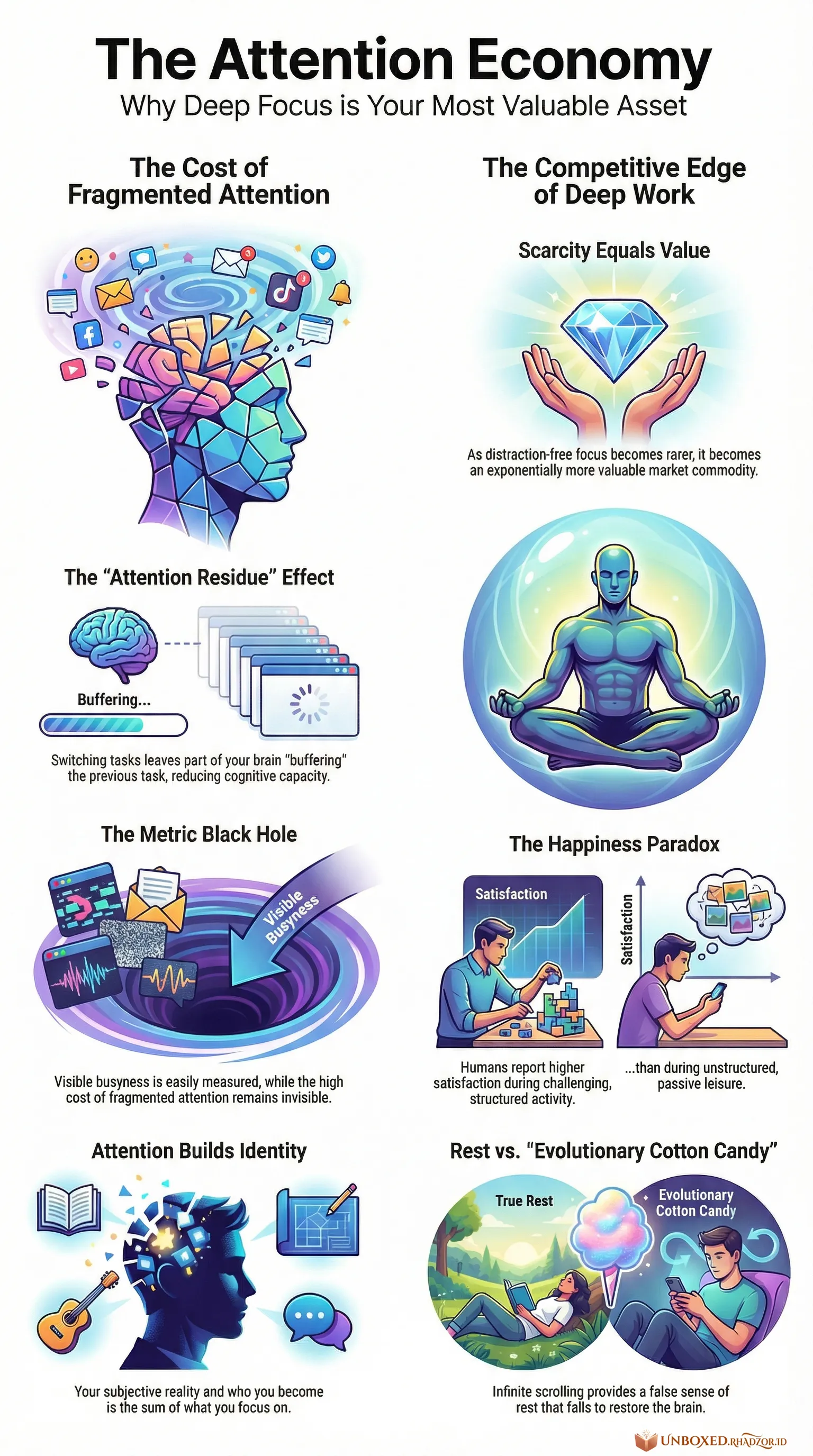
Here's something worth sitting with: we live in the most information-rich period in human history, and yet our ability to actually *think* — to hold a hard problem in our heads long enough to do something useful with it — might be at an all-time low.

Cal Newport doesn't say this with alarm. He says it the way an economist would describe a market inefficiency. Matter-of-fact. Almost bored. And somehow that makes it worse.

The core argument is straightforward: deep work — sustained, distraction-free focus on cognitively demanding tasks — is becoming rare. And because it's becoming rare, it's becoming enormously valuable. This isn't self-help rhetoric. It's basic supply and demand.

---

But the more interesting question isn't *what* he argues. It's *why* we keep failing at something that should, in theory, be simple.

Think of your attention like a browser with too many tabs open. Every time you switch from one task to another — from a document to a Slack message, from deep thinking to a quick email check — the previous tab doesn't fully close. Newport calls this "attention residue." You've moved on, but part of your brain hasn't. It's still buffering the last thing you were doing.

Multiply that across an eight-hour workday. Multiply it across years.

What you get isn't productivity. What you get is a brain that has quietly normalized operating at half capacity — and worse, has stopped noticing anything is wrong.

---

There's a darker paradox buried in here that Newport touches on without fully unpacking, but the implication is hard to ignore:

The companies most aggressively promoting open collaboration — open offices, always-on messaging, daily standups, "spontaneous innovation" — are the same companies most efficiently dismantling the conditions that make real innovation possible.

They've built cultures where *looking busy* is far more measurable than *producing something that matters*. And because no one can put a dollar figure on the cost of fragmented attention, no one sounds the alarm. Newport calls it a *metric black hole* — damage that never shows up on a balance sheet, but is absolutely real.

It's the corporate equivalent of slowly polluting a river and calling it progress because the factory numbers look good.

---

This is the line that made me stop:

*"Who you are, what you think, feel, and do, what you love — is the sum of what you focus on."*

Newport borrows this from Winifred Gallagher, a science journalist who spent years researching the neuroscience of attention. And the implication goes well beyond productivity.

If your subjective reality is genuinely constructed from what you pay attention to — not what happens to you, but what you *choose to look at* — then three hours of late-night scrolling isn't just wasted time. It's actively *building the version of you* that exists tomorrow.

That's not moralizing. That's just how the neuroscience reads.

---

Newport also brushes against something counterintuitive about happiness that I think deserves more airtime: we are consistently, demonstrably bad at predicting where happiness actually comes from.

We assume free time will restore us. We assume that if we could just *not work* for a while, we'd feel better. But the psychological data keeps pointing the other way — humans tend to report higher satisfaction during challenging, structured activity than during unstructured leisure.

This isn't an argument for grinding yourself into the ground. It's more of an uncomfortable reminder that a brain shaped by hundreds of thousands of years of problem-solving, building, and creating was not designed with autoplay video and infinite scroll in mind. We handed it the evolutionary equivalent of cotton candy and called it rest.

---

The honest version of this is: the book won't change much if you don't already feel the friction.

And most of us don't — because everyone around us is equally distracted, equally scattered, equally exhausted. That shared condition feels like normalcy. It isn't evidence that nothing is wrong. It's just evidence that we're all treading water at the same depth.

I still pick up my phone for no clear reason in the middle of working. I still lose to notifications. But at least now I know exactly what mechanism is firing inside my head when it happens — what it's costing, and why it compounds.

Does knowing that change the behavior?

Not automatically. But it's a more honest starting point than just deciding to "be more focused" starting Monday.