There are books you finish in a single night but that haunt your thinking for years afterward. The Lessons of History is one of them. Will and Ariel Durant spent decades writing The Story of Civilization across eleven dense volumes, then distilled it all into one slim book centered on one question: after everything, what have we actually learned from human history?
The answers are not always comfortable. That is exactly why this book matters.
Humans Are Part of Nature, Not an Exception to It
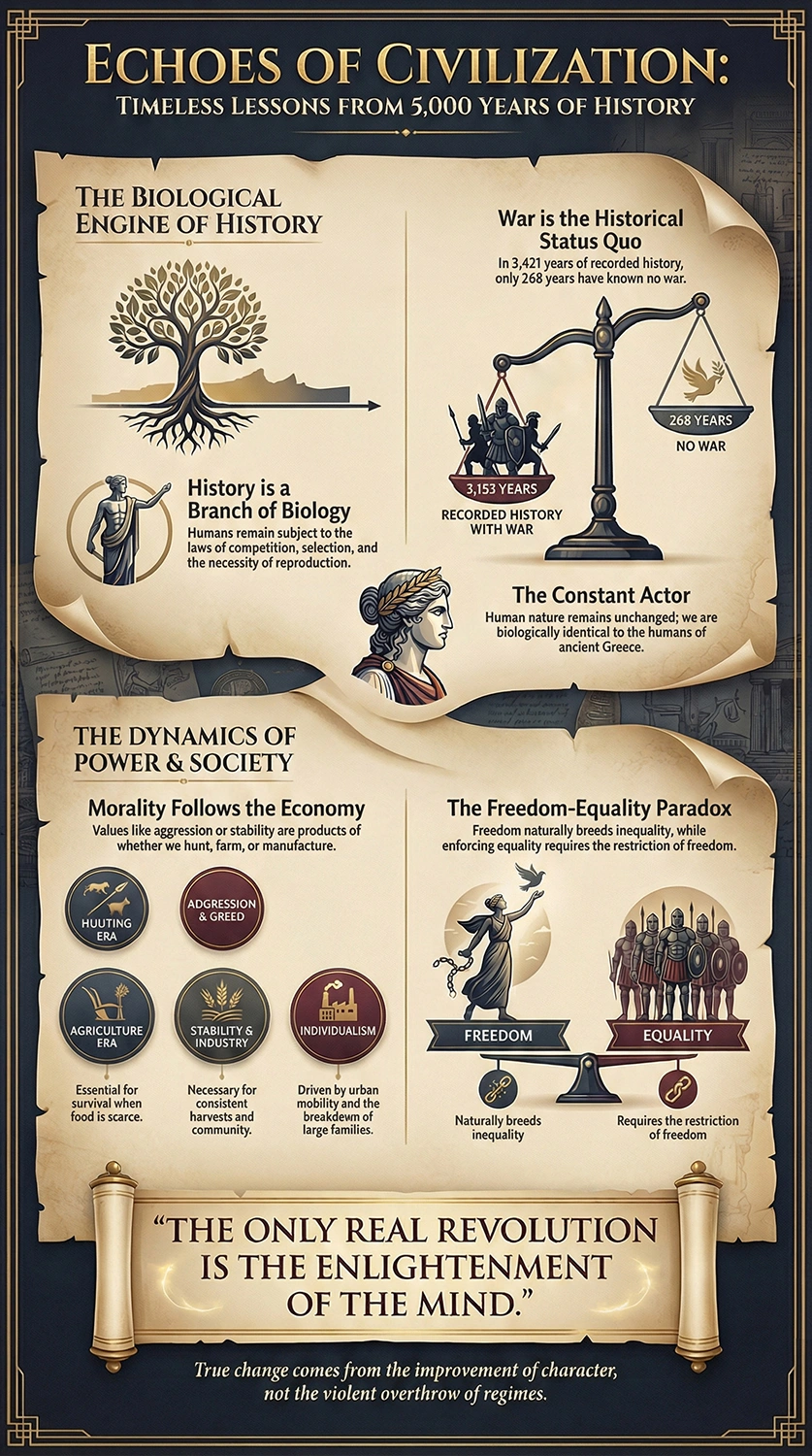
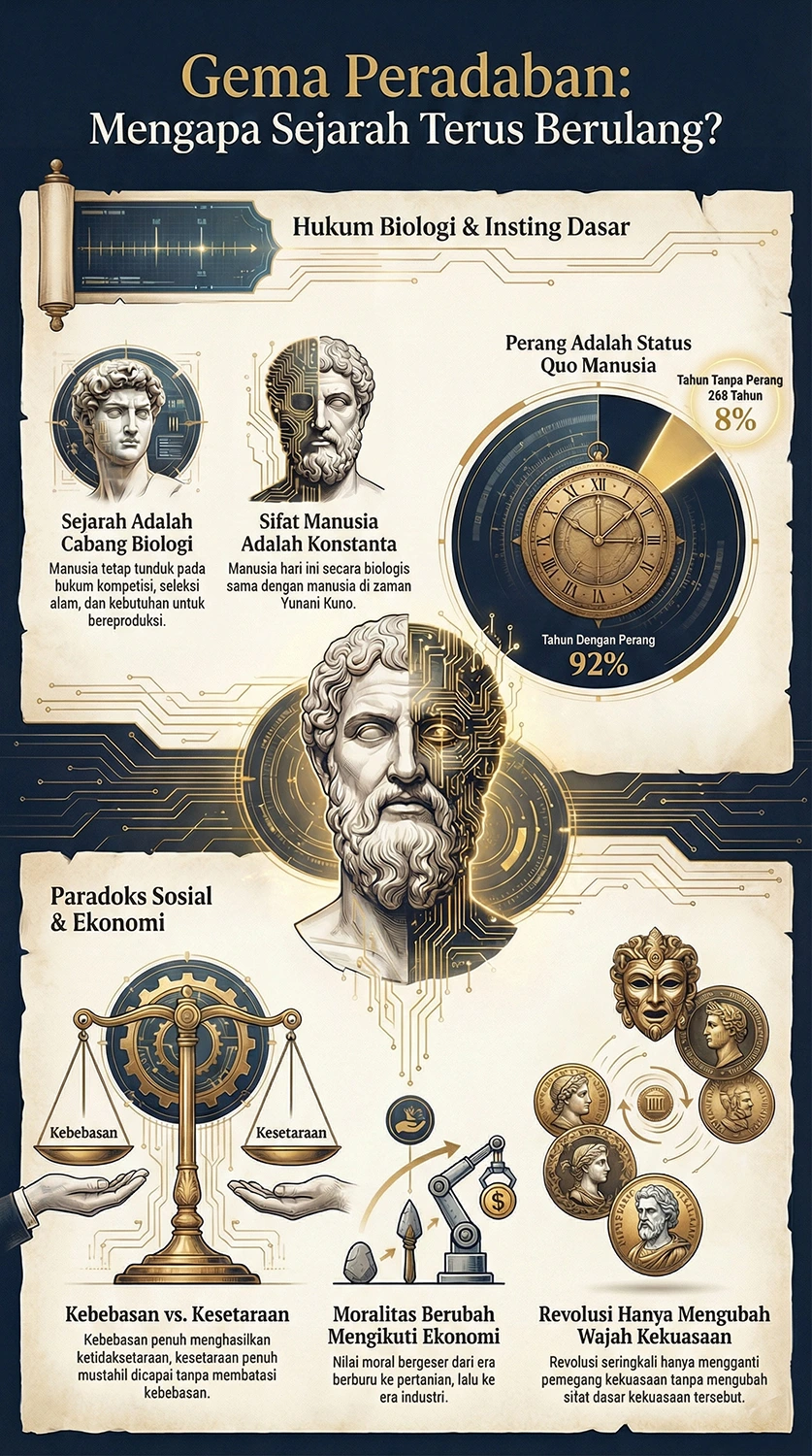
Durant starts with a hard premise: human history is a branch of biology. Before discussing empires, revolutions, or ideologies, we have to admit we are still governed by the same natural laws as every other living organism.
The first law is competition. Cooperation inside families, communities, and nations is often a strategy for competing more effectively against other groups. Peace within, rivalry without.
The second law is selection. Human beings are not born equal in physical capacity, intelligence, or character. Nature does not optimize for fairness; it optimizes for survival and reproduction.
The third law is continuity of life. Nature does not prioritize individual quality as much as species continuity. Across history, advanced civilizations with low birth rates were repeatedly absorbed by simpler but more fertile peoples.
The implication is uncomfortable: our skyline has changed, our core instincts much less.
Human Nature Is the Constant Beneath Change
Technology changes quickly, social norms shift, and institutions evolve. Durant argues human nature itself changes far more slowly. Biologically and psychologically, an ancient Greek and a modern executive are not as different as we like to imagine.
History is often the same actors playing similar roles on a different stage. That is why older history can still explain modern politics and leadership behavior with surprising clarity.
Morality Is Shaped by Economics
Durant does not dismiss morality. He argues that moral codes are strongly conditioned by economic structure.
In hunting societies, aggression and resource capture were survival virtues. In agricultural societies, stability and restraint became moral priorities. In industrial society, urban economics transformed family structures, delayed marriage, and shifted social values again.
The question he leaves us with is still relevant: what morality is being quietly shaped by the digital and AI era?
Equality and Freedom Cannot Fully Coexist
Durant argues that complete freedom and complete equality cannot be maximized at the same time. With broad freedom, inequality tends to grow because talent, luck, and discipline compound unevenly. With strict equality, power must concentrate in institutions that allocate outcomes, and that often reduces freedom.
He describes economic history as a pulse: concentration upward, then redistribution through reform or rupture. The adjustment can be peaceful, or it can be violent.
Revolution Often Changes Faces, Not Power's Character
Durant is skeptical of violent revolution as a durable solution. In many cases, new rulers adopt old instincts once in power: consolidation, protection of insiders, and suppression of dissent.
"The only real revolution is in the enlightenment of the mind and the improvement of character. The only real revolutionists are philosophers and saints."
War Is the Default, Not the Exception
Durant notes that out of 3,421 years of recorded history, only 268 were free of war. For him, war is not an accident outside civilization; it is one recurring expression of group competition.
Long peace is possible, but it is historically rare and requires continuous effort.
So, Has Humanity Progressed?
Durant's answer is nuanced. Progress is not guaranteed in happiness or morality, and technology is morally neutral. But there is one real form of progress: accumulated social inheritance.
Each generation receives not only genes, but also law, science, art, institutions, and memory. Civilization migrates, transforms, and is transmitted through education.
History is not just a catalogue of repeated mistakes. It is a library we can use to face the future with clearer eyes.